
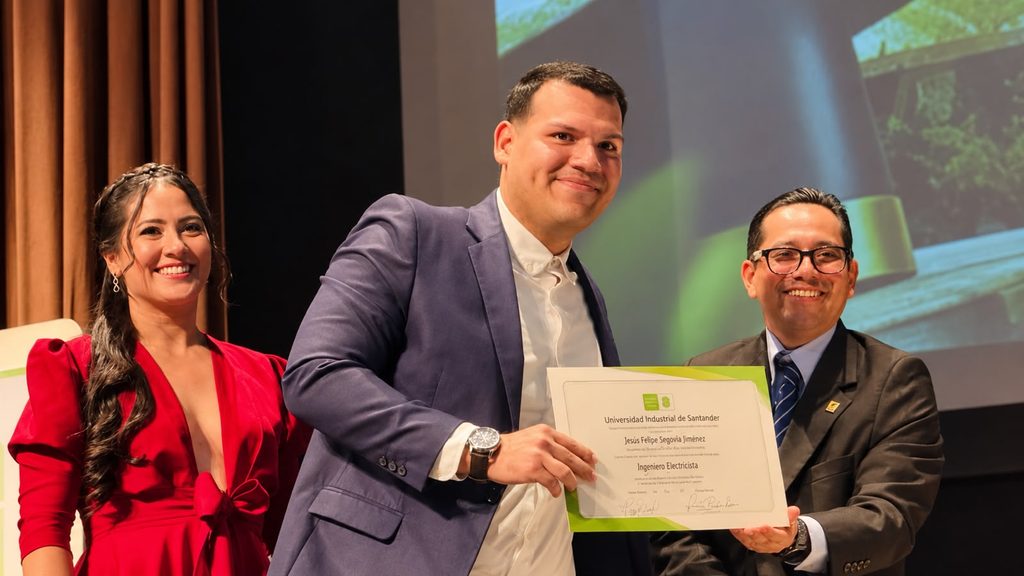
After seven years of academic training, dedication, and perseverance, Jesús Felipe Segovia Jiménez received his degree in Electrical Engineering from the Universidad Industrial de Santander (UIS). His story also leaves behind a tool designed to facilitate access to knowledge for other Deaf people.
Today, during the graduation ceremony at the Universidad Industrial de Santander, Jesús Felipe Segovia Jiménez received his degree as an Electrical Engineer, completing seven years of university education and becoming the first Deaf sign-language-using electrical engineer in the country.
His journey at the university began with a decision that he remembers as an act of determination: enrolling in a demanding degree program and taking on the challenge of pursuing it as a Deaf person and user of Colombian Sign Language.
“I set myself the goal and took the risk. I said, ‘I’m going to enroll.’” Jesús Felipe recalls when describing the decision that marked the beginning of this journey.
Seven years later, that decision became a professional degree and an experience that, for him, represents much more than completing a university program.
“I feel very proud and optimistic because I can show that I am capable, naturally, just like anyone else,” he says.
A degree that became a purpose
During his training as an electrical engineer, Jesús Felipe encountered a challenge that went beyond the subjects and technical content of his degree: the limited availability of specialized terminology in Colombian Sign Language for engineering concepts.
That need became the starting point for his graduation project, which focused on developing an online technical dictionary prototype in Colombian Sign Language for Electrical Engineering, specialized in systems. The proposal was registered by UIS as his graduation project.
For years, Jesús Felipe worked on identifying and understanding technical terms, their meanings, and the possibilities for representing them in Colombian Sign Language.
But the purpose of this work went beyond fulfilling an academic requirement.
“The goal was not simply to graduate, but to help other Deaf people communicate and give them tools for access,” he explains.
In this way, the knowledge he developed throughout his degree can also become a resource for those who, after him, choose to pursue engineering or other technical fields.

A university that supported his journey
Jesús Felipe’s story was also accompanied by the work of members of the university community and by the initiatives developed by UIS to support his participation in academic life.
Throughout his education, he had access to interpreting services and institutional support. During the final stage of his degree, he was accompanied by Luisa Fernanda Hernández Valdivieso, a professor affiliated with the School of Languages and the School of Law and Political Science at UIS, as well as a Colombian Sign Language instructor.
For Hernández Valdivieso, supporting this process involved much more than interpreting academic content. It required coordinating schedules, understanding the particularities of Colombian Sign Language, and facilitating communication among different members of the university community.
“The university made time and resources available, both human and financial. That is what change involves. These are called reasonable accommodations,” she explains.
The professor also highlights Jesús Felipe’s commitment throughout his academic journey and the collaborative work that made it possible to accompany him through the completion of his degree.
“I feel very proud of Jesús for his great effort, and of the university for stepping up and working together for society,” she says.
UIS has highlighted that Jesús Felipe’s academic journey was supported by institutional initiatives such as SEA and UIS Somos Todos, as well as Colombian Sign Language interpreting services.
“The constant struggle is what has allowed me to overcome these challenges”
For Jesús Felipe, the journey was not without difficulties. However, every challenge became part of a process that today allows him to look back with pride and also think about those who will follow in his footsteps.
His university experience allowed him to identify barriers, seek alternatives, and contribute to the development of tools that can facilitate access to higher education and specialized knowledge for other Deaf people.
“The constant struggle is what has allowed me to overcome these challenges and prove to myself that I can do it, that I can help change the future at the university, in inclusion and accessibility, so that it becomes part of democracy,” he says.
Today, as he receives his degree as an Electrical Engineer, Jesús Felipe Segovia Jiménez not only completes seven years of professional training. He also leaves behind a story that brings together education, accessibility, Colombian Sign Language, and inclusion, as well as a tool developed through engineering for those who may follow a similar path.
His graduation marks the end of one stage and the beginning of another: that of a professional entering the field of engineering carrying an experience that has already become part of the history of the Universidad Industrial de Santander.