


n Santander, one of the regions of Colombia where Chagas disease has historically been most prevalent, infection with the Trypanosoma cruzi parasite continues to silently claim victims. Although for years this disease was associated solely with heart or digestive system problems, research conducted by the Industrial University of Santander (UIS) raises a critical warning: Chagas disease is closely linked to the occurrence of ischemic strokes, commonly known as a “brain stroke” or “cerebral infarction.”
The study, titled “Chagas Seropositivity in Ischemic Stroke: Greater Neurological Severity and Cardioembolic Damage in Santander, Colombia,” is the largest published patient series in the country on this relationship in the last 20 years. Conducted at the Santander University Hospital (HUS), the study evaluates how the infection affects the health status of patients admitted to the emergency department following the blockage of a cerebral artery.
“Hidden Chagas”
One of the most striking findings of the study is the high proportion of infected patients. While it is estimated that about 2% of the general population in Colombia has Chagas disease, among patients admitted to the HUS for an ischemic stroke, the figure soared to nearly 30% (3 out of every 10 people).
Laura Marcela Rey, a resident physician in the Internal Medicine program at the UIS and one of the lead researchers, explains the motivation for investigating this phenomenon in the department: “Santander is one of the departments with the highest prevalence of Chagas disease in Colombia, and at the University Hospital of Santander, we frequently treat patients with stroke. It struck me that there are few Colombian studies on the subject—many of which were conducted more than 20 years ago—and that research in Santander is limited. Furthermore, in other countries it has been observed that many people are diagnosed with Chagas disease after suffering a stroke, because the infection can remain asymptomatic for decades. I wanted to know if the same thing was happening here.”
Many of those affected were completely unaware that they were carriers of the parasite until they arrived at the emergency room—or even after having suffered previous cerebrovascular episodes.
A Weakened Heart Prone to Clots
Over the years, the Chagas parasite gradually inflames and destroys the heart’s muscle fibers, causing the heart to enlarge, lose its pumping strength, and beat at an irregular rhythm (arrhythmias), explains Dr. Rey.
When blood does not flow smoothly and the heart does not beat properly, clots form inside it. Subsequently, a clot can break off, travel through the bloodstream to the brain, and block a key artery, depriving nerve cells of oxygen. This is what is known in medicine as a cardioembolic stroke.
“If the heart beats irregularly or doesn’t pump well, blood clots can form inside it. If a clot breaks loose, it travels to the brain and blocks an artery, causing a stroke. This is what we call a cardioembolic stroke. In our patients with Chagas disease, the heart was much more severely affected: 45% had significantly reduced pumping capacity, compared to 13% of patients without Chagas disease. Only 3 out of 10 had a normal electrocardiogram, compared to nearly 8 out of 10 among the others. In addition, they more frequently presented with arrhythmias and a history of another stroke,” says Dr. Rey.
A Distinct Pathway to Stroke
Traditionally, strokes have been attributed to well-known risk factors such as high blood pressure, diabetes, hypercholesterolemia, or smoking. However, the research revealed that these factors were very similar between the two groups of patients, and patients with Chagas disease even had slightly lower glucose levels.
“The usual risk factors do not explain these cases. High blood pressure, diabetes, and smoking were similar in both groups, and patients with Chagas disease even had slightly lower glucose levels. This suggests that Chagas disease leads to stroke through a distinct mechanism: in addition to damaging the heart, the parasite causes inflammation in the blood vessels and increases the blood’s tendency to clot,” explains Dr. Rey.
Neurological Severity and Life Prognosis
To measure the impact of a stroke, neurologists use the NIHSS scale, a standardized tool that assigns a score based on the loss of motor function, speech, or level of consciousness.
Patients with Chagas disease were admitted with a median score of 11 on this scale, compared to 7 points for those without the infection. Although this 4-point difference indicates a clear trend toward more severe neurological symptoms, the researchers note that it requires confirmation in studies with larger sample sizes to achieve strict statistical significance.
A statistically significant finding was observed in the NIHSS score as a direct indicator of in-hospital mortality: for every additional point a patient scored upon admission, the risk of death increased by 11% (RR 1.11; 95% CI: 1.04–1.19; p=0.003).
“It’s a cumulative effect: assuming the increase is constant, a patient admitted with a score of 11 would have a risk of death nearly 50% higher than one admitted with a score of 7,” the researcher points out.
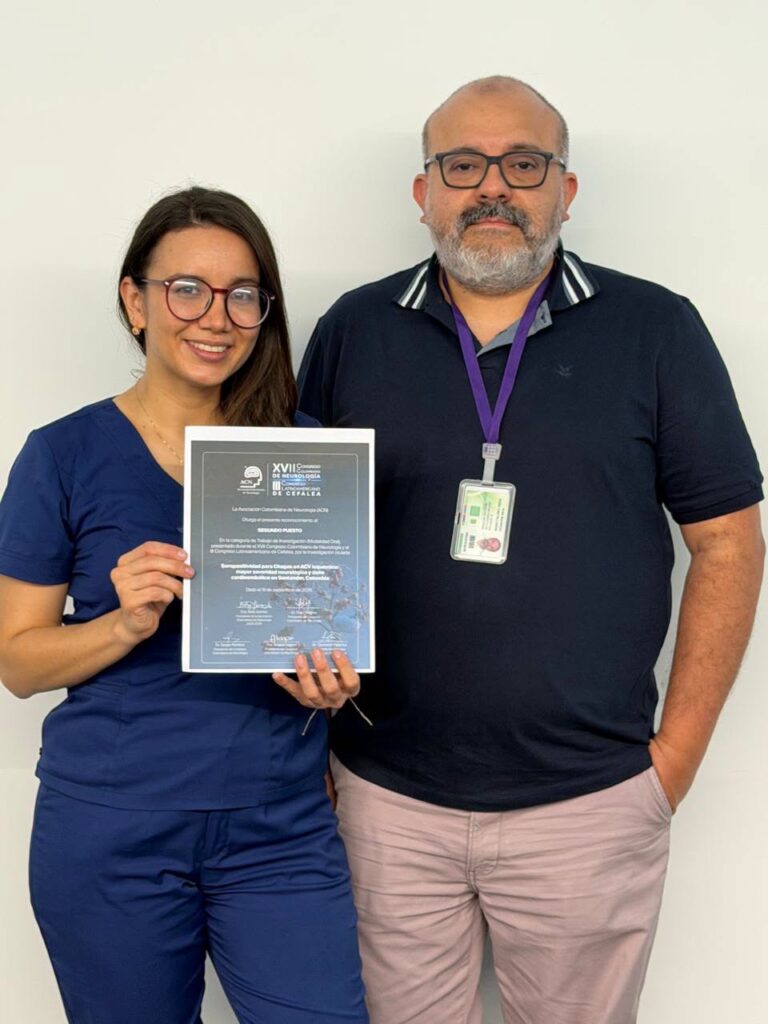
The research study—led by Dr. Iván Mauricio Peña Castellanos (neurologist and project director), Dr. Laura Marcela Rey (internal medicine resident), Dr. Claudia Lucía Figueroa (internist, epidemiologist, and co-director), along with medical students Simón Rincón Hernández and José Daniel Molina—has received significant recognition within the scientific community.
The study won second place in the oral presentation category for research papers at the 17th Colombian Congress of Neurology and the 3rd Latin American Congress on Headaches, organized by the Colombian Association of Neurology (ACN). In addition, it has been presented at the Ibero-American Congress on Cerebrovascular Diseases (Panama City, 2025) and the Colombian Congress of Cardiology (2026), and will represent the scientific community of Santander at the Latin American Congress of Parasitology (FLAP 2026).
This achievement by the School of Health at the Industrial University of Santander underscores the crucial importance of generating local scientific research that has a real impact on the health of communities in northeastern Colombia.