
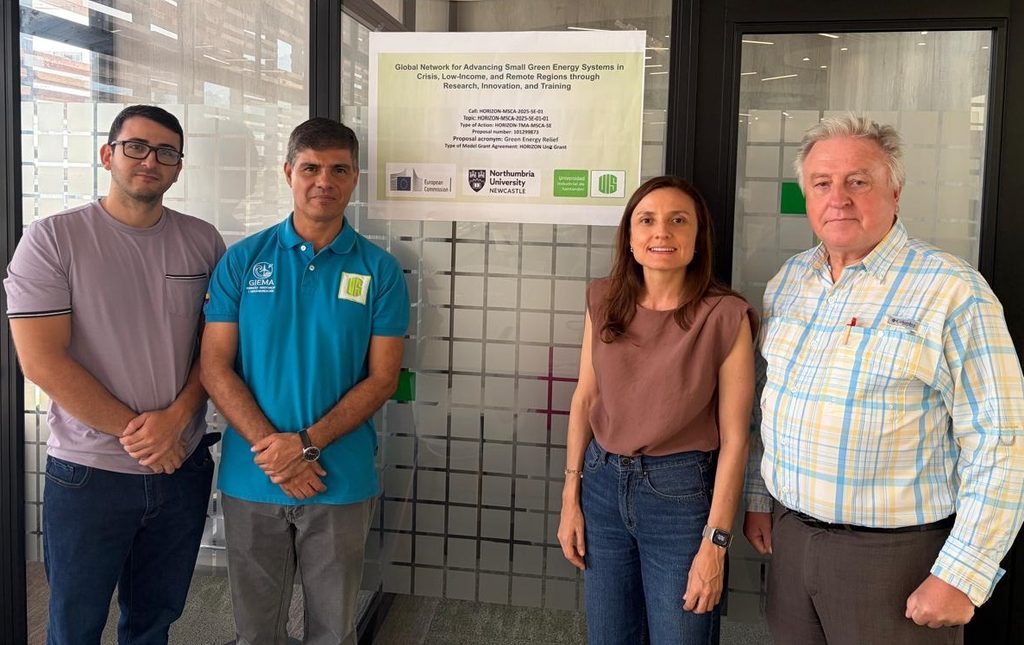
From right to left: Prof. Viatcheslav Kafarov, Prof. María Alejandra Mantilla Villalobos, Prof. Julián Ernesto Jaramillo Ibarra, and doctoral student Nicolas Cabrera Ruiz.
The Universidad Industrial de Santander (UIS) is strengthening its participation in international research initiatives by joining the European Union’s HORIZON-MSCA (MSCA – Academic Exchange) project, entitled “Global Network for Advancing Small-Scale Green Energy Systems in Crisis, Low-Income, and Remote Regions through Research, Innovation, and Training,” under the acronym Green Energy Relief.
With a duration of 48 months and focused on Information Sciences and Engineering, the project aims to research, develop, demonstrate, and implement small-scale green energy systems with storage capabilities that can operate independently of the electrical grid.
These solutions will be designed to be transported, installed, and deployed rapidly to provide electricity, heating, and cooling to vulnerable populations affected by natural disasters and geopolitical events, as well as communities located in remote areas.
Energy to respond to emergencies
The need for these technologies becomes particularly evident in situations such as earthquakes, where the destruction of power grids, water systems, and communications infrastructure can hinder rescue efforts and leave communities and refugee camps without basic services.
Against this backdrop, Green Energy Relief seeks to promote autonomous and reliable systems that harness renewable and locally available resources to generate electricity and heat under emergency conditions.
A global scientific partnership
The project brings together 18 teams from 12 countries: Belgium, Italy, Spain, France, Germany, Türkiye, the United Kingdom, Brazil, Colombia, Cuba, South Africa, and Uzbekistan. The initiative involves universities and companies from Europe, associated countries, and developing nations, which will contribute their expertise in research, innovation, and entrepreneurship.
The teams will work collaboratively on research, knowledge exchange, and training, with a particular focus on strengthening the capabilities of researchers and engineers in the early stages of their careers.
UIS talent contributing to a global solution
The UIS principal investigator is Professor Viatcheslav Kafarov, director of the CIDES Research Center at the School of Chemical Engineering.
Also participating are Professor Julián Ernesto Jaramillo Ibarra, from the Energy and Environment Research Group (GIEMA) of the School of Mechanical Engineering; Professor María Alejandra Mantilla Villalobos, from the Electric Power Systems Research Group (GISEL) of the School of Electrical, Electronic and Telecommunications Engineering; and doctoral students Nicolas Cabrera Ruiz, from Chemical Engineering, and Andrés Felipe León Esteban, from the Doctorate in Engineering, with an emphasis on the area and management of technological development.
Through this participation, the UIS contributes its scientific expertise and the talent of its researchers and students to an initiative seeking to transform renewable energy into a tool for resilience for communities facing some of the world’s most challenging conditions.