
Colombia, recognized as the world’s largest producer of mild coffee and the third-largest coffee producer globally, faces the challenge of maintaining crop productivity without compromising soil health. In this context, qualitative chromatography emerges as an innovative tool that allows for the assessment of soil biological activity and paves the way toward more sustainable regenerative agriculture models.
With the aim of strengthening more sustainable production models, Professor Tulio Esteban Lozano Vesga, a faculty member at the Institute for Regional Development and Distance Education (IPRED – UIS) and a graduate of the UIS Agroindustrial Production program, is promoting the use of qualitative chromatography, a methodology that allows for the evaluation of soil biological activity, the presence of organic matter, and the balance of productive ecosystems.
As the expert explains, the technique provides insight into the biological health of soils, strengthens crop sustainability, and improves coffee quality from root to cup.
“Basically, chromatography works like a photograph or an X-ray of the soil. Rather than providing numbers or results that are difficult to interpret, it helps us observe how life is functioning within the soil: whether there is good oxygenation, the presence of minerals, active organic matter, and, above all, microbiological activity”, says Lozano Vesga.
This is achieved by first mixing the soil with certain reagents and treating the paper with other special solutions. Chromatography can be used to determine whether the soil is balanced and regenerating or, conversely, whether it is depleted, compacted, or degrading due to poor agricultural practices.
“This microbiology—those tiny microorganisms present in the soil—is what truly gives it life, balance, and harmony. Thanks to them, nutrients can be transformed and made available to plants,” explains the researcher.
Beyond its productive function, the technique helps us understand that soil is a living ecosystem whose health determines the sustainability of all agricultural activity.
Rapid Analysis
Using chromatography, the producer can quickly and visually observe whether the practices they are implementing are regenerating the soil or degrading it.
“Through the chromatograms, the coffee grower can identify signs of balance or detect problems related to compaction, loss of organic matter, low microbiological activity, or an excess of synthetic chemical products,” states Lozano Vesga.
The information obtained facilitates decision-making regarding the agronomic management of crops, guiding strategies such as the use of organic fertilizers, the implementation of cover crops, and the reduction of chemical inputs.
“Often, the soil appears healthy from the outside, but the chromatogram reveals internal imbalances that are not yet visible in the crop,” notes the UIS professor.
“From Soil to Cup”
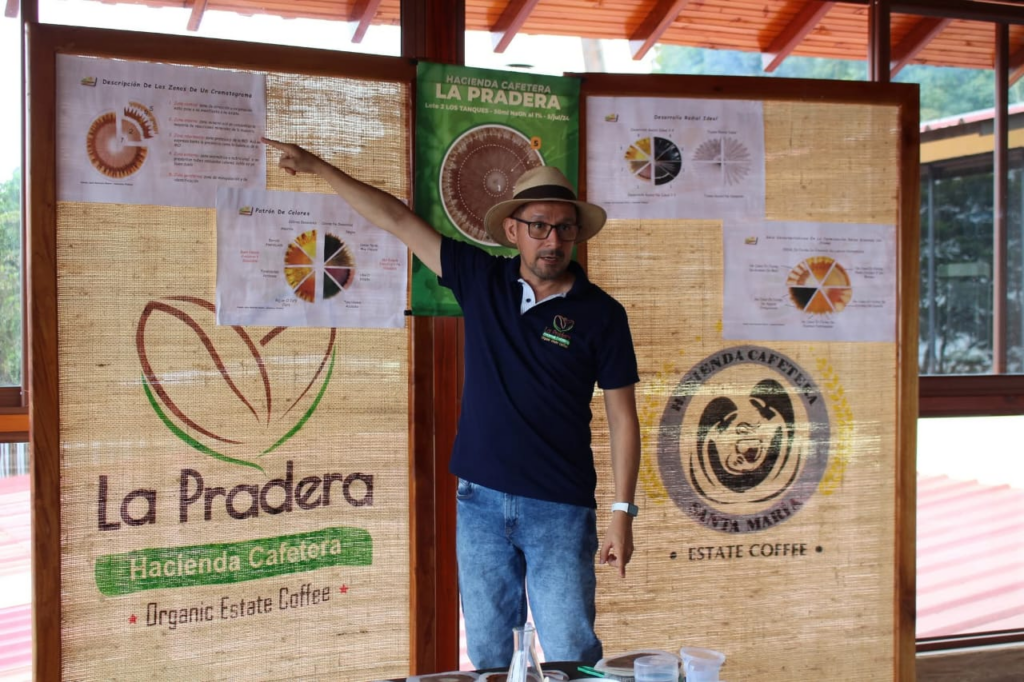
Currently, the UIS professor explains, he is developing “From Soil to Cup,” a project being carried out at an organic coffee farm in Santander where chromatographic analyses are being conducted on compost, soil, foliage, pulp, green coffee, and roasted coffee. The goal is to establish a biological and regenerative traceability system for coffee, demonstrating how soil health directly influences the final quality of the cup.
Chromatography serves not only as a diagnostic tool but also as a traceability mechanism that highlights the work done on the farm and demonstrates sustainable and regenerative practices.
He explains that the technique allows for an understanding of soil biological health, strengthens crop sustainability, and improves coffee quality from root to cup.
“Colombian coffee farming is moving toward more sustainable production models thanks to tools that provide a comprehensive understanding of soil health. Among these, qualitative chromatography stands out—a methodology gaining ground in regenerative agriculture by offering a detailed view of biological activity, organic matter, and the balance of productive ecosystems,” says Lozano Vesga.
More than just a conventional laboratory analysis, this technique acts as a “living X-ray” of the soil. Furthermore, by examining the patterns and colors that appear on the filter paper, farmers can assess the health of their crops and make informed decisions to improve farm productivity and sustainability.
“Agroecology specialists point out that qualitative chromatography complements traditional chemical analyses. While these determine the amount of nutrients present in the soil, chromatography reveals how those elements interact with organic matter and the microorganisms responsible for natural fertility,” asserts the UIS professor.
Among its main advantages, he says, are the low cost of implementation, the ability to conduct frequent monitoring without relying on external laboratories, and its educational value for farmers, students, and rural communities. It also facilitates the early detection of problems such as compaction, loss of microbial biodiversity, or effects resulting from the excessive use of agrochemicals.
Sampling
Research and projects conducted in coffee-growing regions have shown that the biological health of the soil directly influences coffee quality. Soil with high microbiological activity promotes root development in plants, improves nutrient absorption, and contributes to the formation of compounds that determine the aroma, flavor, and quality of the beverage.
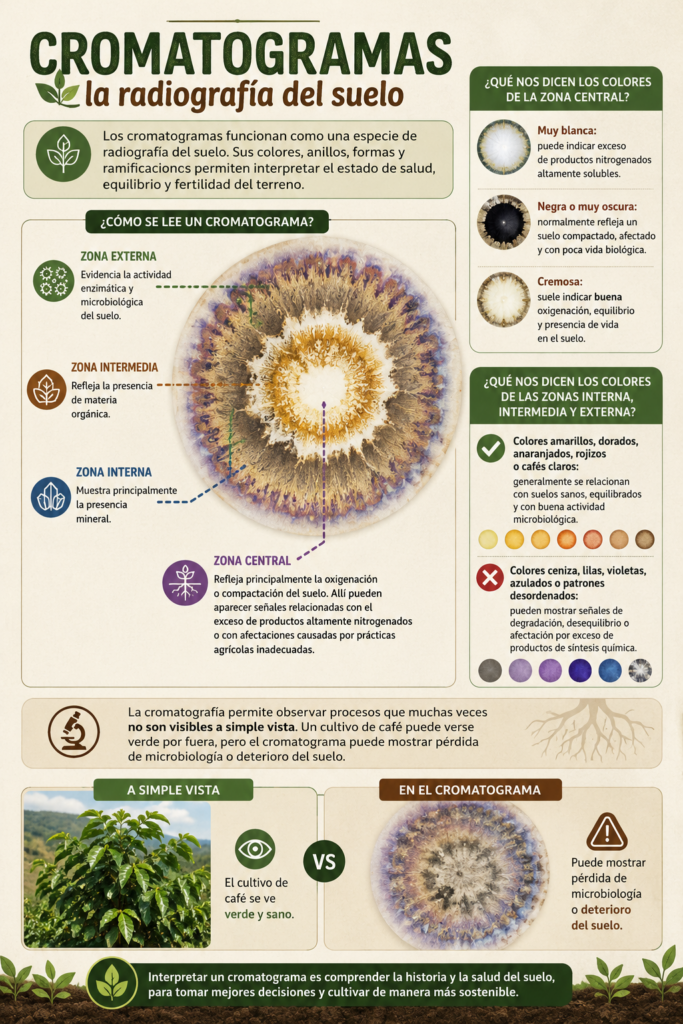
This technology employs a methodology that requires a rigorous process of sampling, drying, grinding, and preparing reagents. The sample is then subjected to a series of chemical reactions that generate a chromatogram—an image reflecting the interaction between minerals, organic matter, and microbiological activity.
Lozano Vesga explains that these results are interpreted by analyzing different concentric zones.
On the one hand, yellow, gold, orange, and light brown colors are associated with balanced and healthy systems, while gray, violet, bluish, or black tones indicate processes of degradation, compaction, or biological imbalances.
This tool offers benefits that go beyond soil diagnosis. “Experts believe that the expansion of this methodology represents an important step toward coffee farming with greater biological traceability. In addition to reducing dependence on external inputs, it strengthens producers’ autonomy and promotes management based on an understanding of the living processes occurring beneath the surface,” says Lozano Vesga.
In this way, qualitative chromatography establishes itself as a strategic tool for the future of Colombian coffee, contributing to soil conservation, the sustainability of production systems, and the maintenance of the quality standards that distinguish the national bean in international markets.
Coffee Quality
For the UIS professor, coffee quality begins with the soil. He also asserts that if the soil is healthy, alive, balanced, and harmonious, this is ultimately reflected in the plant, the fruit, and finally in the cup of coffee.
“But if the soil is degraded, compacted, or unbalanced, that impact also ends up affecting the quality of the crop and the sustainability of the production system,” he adds.
The fact is that soil health directly influences the coffee plant’s nutrition, the tree’s development, the physical quality of the fruit, and the sensory characteristics of the cup.
“In projects like ‘From Soil to Cup,’ currently underway at an organic coffee farm in Santander, chromatography has first enabled us to improve the quality of organic fertilizers. By improving the fertilizers, we improve the soil; by improving the soil, we improve the coffee tree; and by improving the coffee tree, we improve the fruit and the final quality of the coffee,” he explains.
Furthermore, chromatography is enabling the development of traceability processes that demonstrate not only the quality of the cup but also everything behind the coffee—soil management, environmental impact, regenerative practices, and the responsible work carried out by producers.
Today, many international markets are not only looking for coffees with a good cup profile, but also coffees that demonstrate sustainability, biological balance, and environmental responsibility. In this context, chromatography can become a very valuable tool for demonstrating these processes within coffee farms.