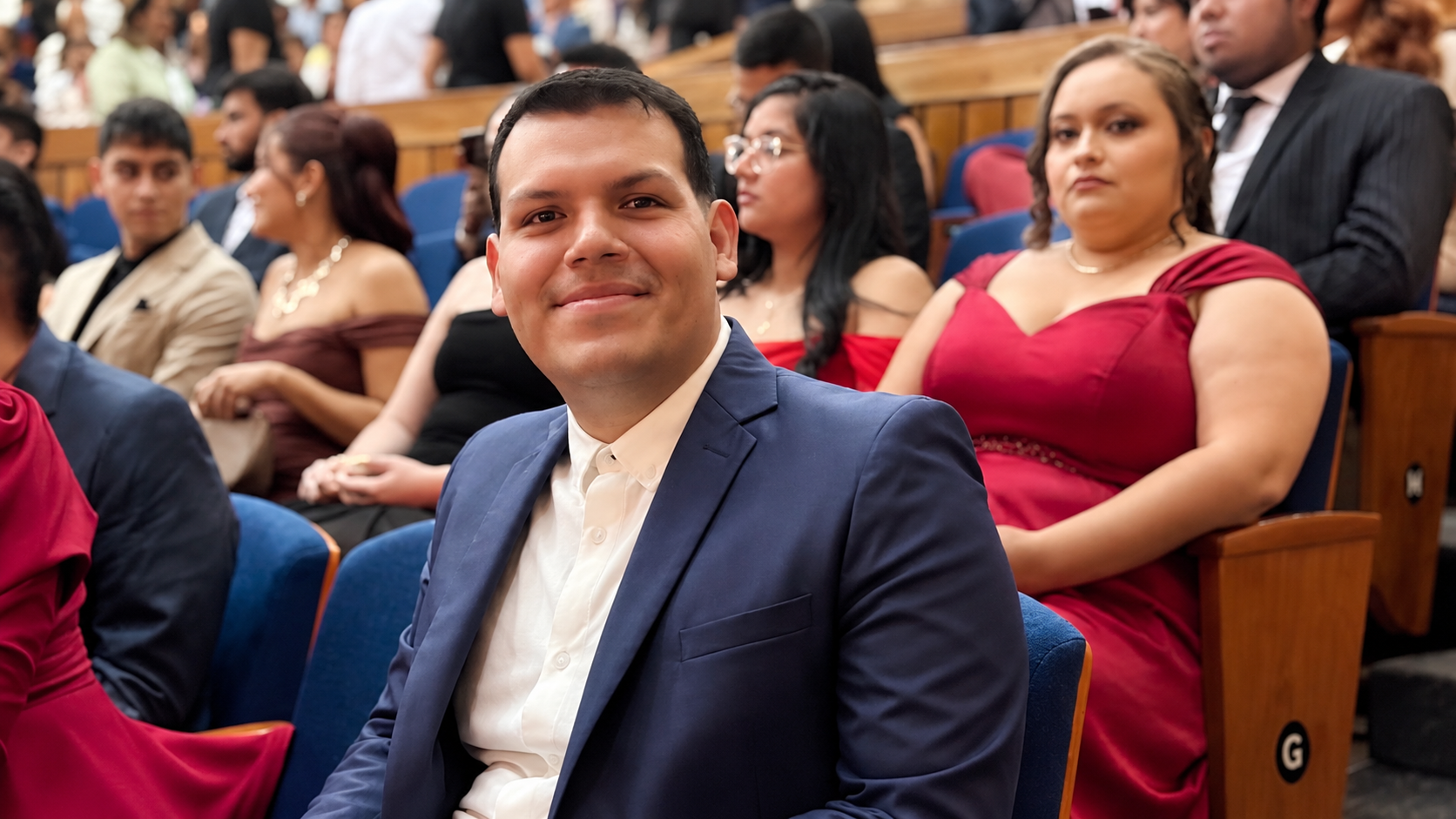


Sometimes life changes overnight, and only we can decide whether to make the best of adversity, continue on our path, transform ourselves, and leave an indelible mark. Camilo Carranza Ariza, a music graduate from the Industrial University of Santander (UIS), is a testament to this.
One morning in 2018, the clock of life seemed to stop for Camilo. At just 16 years old, he suffered an accident that plunged him into a silence that seemed permanent. As a result of a bicycle accident, he suffered severe traumatic brain injury with diffuse axonal injury, brain damage, and midbrain injury. The outlook was not promising.
“They told my mom that if he survived, the consequences would be irreparable, such as being left in a vegetative state or quadriplegic,” he says.
While his body fought to cling to existence, his mother, father, and brother joined together in a chorus of prayers and hope. In a room at the Hospital Internacional de Colombia (HIC), where science did its part with surgical precision, there was also room for the intangible: faith. A faith that did not bow to the prognosis and ended up being the invisible thread that held the Carranza Ariza family together.

Against all odds and after doctors gave him no more than three days to live, Camilo gradually showed signs of recovery and was discharged from the clinic a month later. His recovery was just beginning, and a long process lay ahead, but his parents did not hesitate to put all their efforts into it and even hired private medical staff to help with the process.
His rehabilitation was slow, sometimes painful, but steady. Every small advance, every movement, every word, every glance that returned, was proof of miracles. This would not be the end of the story, but the beginning of a second chance at life, as he himself says. With therapy and unwavering devotion, time passed, and he managed to regain his life little by little.

Arrival at the University
The same year as the accident, he finished high school and had to focus on starting his university life. He knew he wanted to attend the Industrial University of Santander (UIS) to study mechanical engineering, his dream career. However, his results from the Colombian Institute for the Evaluation of Education (ICFES) did not allow him to enter this program, so he looked for other alternatives. With the advice of the institution’s Admissions Division, the possibility arose to start a Bachelor’s Degree in Music, an option motivated mainly by his taste and passion for musical art.
“I have been involved with music since I was a child. My dad is a self-taught musician and had training in this area. My brother and I formed an urban music group, and in high school, I was part of the marching band playing the cymbals. One day, I picked up a trumpet and managed to make it sound; the teacher noticed my talent and asked me to bring a mouthpiece. That’s how my great love for this instrument was born,” Camilo recalls.

That is how he decided to apply for the Bachelor of Music program at UIS. He prepared for his audition and was accepted.
This program provides theoretical, practical, and pedagogical training. Its purpose is to develop disciplinary mastery among its students in areas such as artistic and musical expression, creation, and professional performance. Likewise, students are trained from a holistic perspective that encompasses not only the inherent features of the particular discipline but also characteristics of humanistic training as citizens committed to democracy and environmental sustainability.
During the first semester, Camilo had to start an academic project, which he called “Music as a means of psychomotor and psychosocial support in the face of physical or cognitive difficulties.” In it, he used his own story and demonstrated how music helps with neurorehabilitation.
“When I had the accident, the neuropediatrician told my family that music would be the key to my rehabilitation. That’s how I found music to be the driving force behind my progress, and I decided to implement it in a class project,” he says.
As the semesters passed, Camilo continued to research and expand his knowledge until, at the end of his degree, he presented his final project entitled “Music as support for people who have suffered an acquired injury.”

“I managed to get Professor Manuel Mejía from the School of Arts on board as project director. Although, as he himself told me, he had no knowledge of neurology and the work required scientific support, we learned together and got it done. I also had a co-director, Brayan Carreño, a physical therapist from the UIS, who guided me on all health-related issues,” Camilo explains.
Finally, his project was approved by the Scientific Research Ethics Committee (CEINCI). This committee is an advisory, consulting, decision-making, and ethical monitoring body for research involving living beings (humans, animals, and plants) carried out by the University in any area of knowledge. Its objective is to ensure that scientific research complies with the ethical principles established in current national and international standards.
“I remember that CEINCI asked me to make adjustments, questioned the information, and asked me to be more precise on some issues; however, in the last communication, they sent me an email saying, ‘Camilo, we bothered you a lot because this is a project that has never been seen before and it is a method that could be innovative, and we want it to become a reality,’” he says.
Camilo graduated from UIS in March 2025. He was a source of pride for his family, especially because he was proof that adversity can be overcome, and that science and God can do anything. Today, there is no trace of the young man who suffered an accident that almost ended his life.
In addition to being a UIS graduate, he has a certification in neurological rehabilitation from the United States. This degree undoubtedly adds value to his work and profession.

From theory to practice
With the completion of his degree project and the certificate obtained, Camilo created a model of rehabilitation through music, which he now implements at the Neurotrauma Center and Cuidamed, where his patients have made great progress.
“I am the music therapist at the Neurotrauma Center and Cuidamed. Due to the progress I have made with my main patient, the management team has told me that we are going to expand the service to more patients,” says the professional.
His work focuses on synaptogenesis, i.e., the restoration of neural connections. He explains that, after trauma, neural disconnections often occur. In his case, he suffered a complete disconnection due to diffuse axonal injury, a severe type of traumatic brain injury that causes widespread damage to the axons, the nerve fibers responsible for transmitting electrical impulses in the brain.

“In my case, I had to restore my neural connections because I started from scratch and had to learn how to walk, talk, everything. So, I work with synaptogenesis to restore the patient’s neural connections and thus achieve greater motor, physical, and cognitive function,” he explains.
Alternately, he is a music teacher for the inclusion group at Santa Teresita School, where he finished his schooling. There, he works with children and young people with attention deficit hyperactivity disorder and in the area of mental health. His work focuses on emotional and sentimental aspects through music.
Camilo is only 23 years old, but his constant desire to improve, learn, and stay up to date has marked his career. With the aim of providing the best for his students, he has trained in different areas and is currently taking courses in music therapy, which he implements with young people through sound therapy to promote their integration and adaptation.
Leaving a mark
Camilo wants to continue leaving his mark with his rehabilitation method, which is why he “feeds” his project with new theories and methods that allow his patients to evolve successfully.
With his thesis entitled “Music as support for people who have suffered an acquired injury,” Camilo was the keynote speaker at the 5th International Congress on Music, Arts, and Health (CIMAS). This event is promoted by the Spanish Society for Music Education (SEM-EE), in collaboration with the City Council of L’Alcora (Castellón, Spain), the L’Alcora Chair of Music Research and Quality of Life, and the Q-HEART Research Group at Jaume I University. At the Congress, Camilo shared his personal experience and the work he has done with a patient at the rehabilitation center where he currently works.

“I stick to my method and implement new methodologies, because health is constantly evolving,” she says.
In September, he was a virtual speaker at the Third International Congress on Artistic and Creative Therapies, an academic meeting that allows participants to expand their existing knowledge of artistic and creative therapies from a constructive and experiential perspective, encompassing knowledge of art therapy, music therapy, dance movement therapy, theater therapy, and other areas related to art psychology.
The long road he has traveled has reaffirmed his great abilities and the certainty that he can go very far if he sets his mind to it.
“When I left the hospital, I did so in a wheelchair, hooked up to machines and unable to speak. Since I couldn’t speak, I just thought, ‘I’m sitting here, but it won’t be for long. I will move forward in the name of God and my family, who have always been with me,’” he recalls.
Camilo has three pillars in his life: God, family, and music, with which he has achieved great things and will continue to do so, as this young music graduate from the UIS has a long and valuable journey ahead of him.