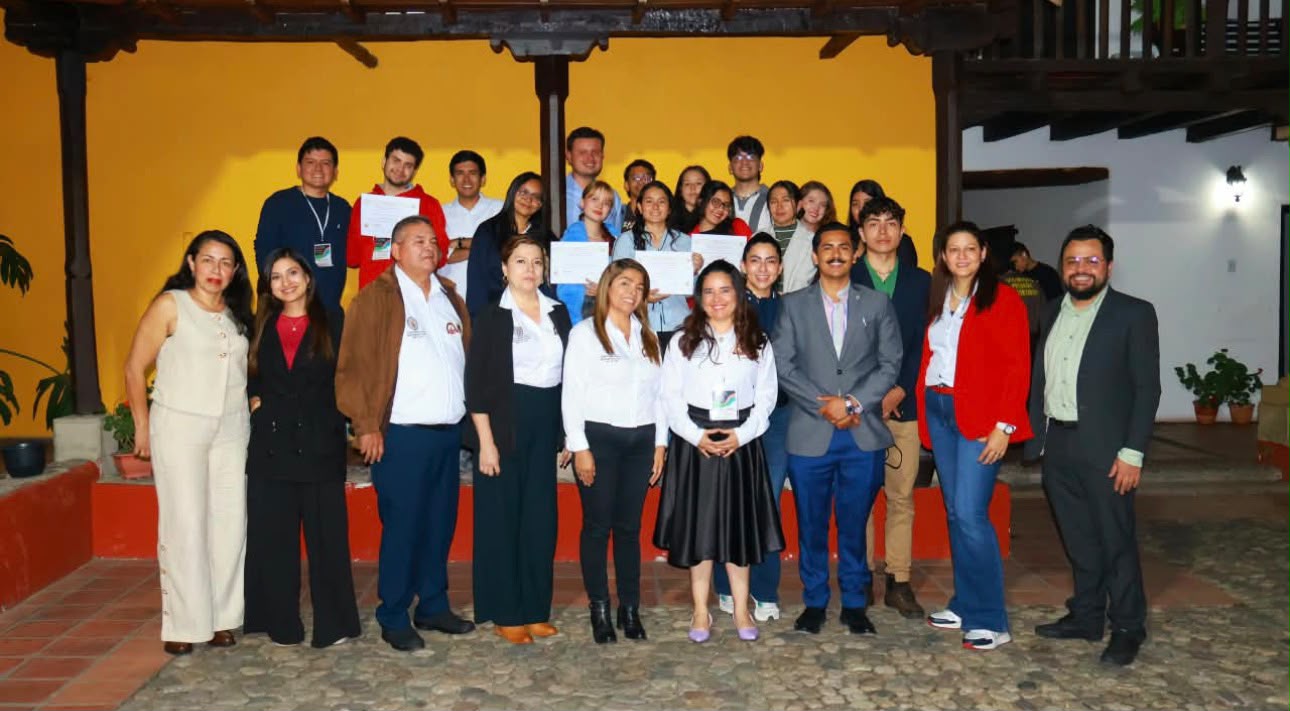


On Tuesday, during a meeting of the Academic Council, the Industrial University of Santander celebrated the presentation of the Manuel Zapata Olivella Award to three postgraduate programs that obtained High Quality Accreditation during the previous year, reaffirming the institution’s commitment to continuous improvement and academic excellence.
During the ceremony, the work of the 18 academic programs that carried out their self-evaluation process in 2025 was also praised, as well as the commitment of the 15 undergraduate and graduate programs that will take on this challenge in 2026, in line with the UIS’s commitment to consolidating a culture of quality.
Professor Olga Mercedes Álvarez Ojeda, academic vice-rector of the UIS, highlighted the significance of this academic event and the coordinated work behind it. “In the Academic Council, we had a very special activity with the academic quality coordination department, where we celebrated the high-quality accreditation of three academic master’s programs: the Master’s in Philosophy, the Master’s in Geophysics, and the Master’s in Human Rights,” she said. She also explained that this recognition was intended to highlight the efforts of programs that are advancing in self-evaluation processes. “In addition, we also wanted to praise those programs that underwent the self-evaluation process last year with a view to obtaining, after the peer review visit expected this year, the renewal of their high-quality accreditation. Last year, 18 programs underwent this self-assessment process,” he said.
Facing new challenges, Álvarez Ojeda highlighted that in 2026, 15 programs will undertake this exercise. “This year, we also wanted to encourage the professors who will be in charge of this self-assessment process, which will involve 15 undergraduate and graduate programs,” she said.
The vice-chancellor emphasized that this sustained growth is the result of a long-term institutional commitment. “This is a wonderful commitment that the Industrial University of Santander has made as part of its continuous improvement, where we have more and more accredited programs. The goal is to have them all accredited,” she emphasized, adding that this process strengthens the University’s ability to offer programs “of the highest technical, scientific, and human quality to northeastern Colombia and all of Colombia.” In total, the UIS has 61 accredited programs.
Accreditation as a collective effort
One of the programs recognized was the Master’s Degree in Human Rights, which received high-quality accreditation for six years. Its coordinator, René Álvarez Orozco, highlighted the participatory nature of the process. “The accreditation process was a collaborative process in which the university community actively participated, from the school administration, the school council, the faculty, the administrative and operational staff, and also with the support and joint effort of the Academic Vice-Rector’s Office and the high-quality programs committee,” he explained.


Álvarez Orozco pointed out that this achievement consolidates the program as a high-level training ground. “With this, the program becomes a high-quality training and qualification opportunity for human rights defenders and promoters, not only in the Santander region, but also throughout the country,” he said.
Regarding the challenges arising from accreditation, he indicated that the commitment continues. “Accreditation means continuing to improve and considering new opportunities. We are currently advancing the process of academic curriculum reform,” he explained, detailing that the program is moving forward with the transition from four to three academic semesters and plans to expand to regional campuses in Barrancabermeja, Socorro, and Málaga.
Quality that is learned and consolidated
For his part, Professor Rafael Torres, director of the School of Physics, celebrated the six-year accreditation of the Master’s Degree in Geophysics, highlighting the institutional learning that these processes leave behind. “The process, like all these accreditation processes, which are very well structured and require the joint work of the entire school, has allowed us to learn from our school and improve the functioning of the program,” he said.
The director emphasized that the increase in the number of years of accreditation reflects greater institutional maturity. “This is part of a learning process, both for the entire team that accompanies and supports us, and also for the schools that have come to understand how the process works,” he said, while affirming that the UIS has always been recognized for the quality of its education and today is able to demonstrate this in a more systematic way.

Finally, Torres highlighted that the culture of self-assessment continues to grow stronger at the School of Physics. “In Physics, we have now begun self-assessment for our undergraduate Physics program, we have just completed self-assessment for our Master’s in Physics, and soon our Doctorate in Physics will also undergo self-assessment,” he concluded.
With this recognition, the UIS continues to focus on quality as an ongoing commitment, built collectively and geared toward the academic and social transformation of the country. In total, the UIS has 61 accredited programs.