
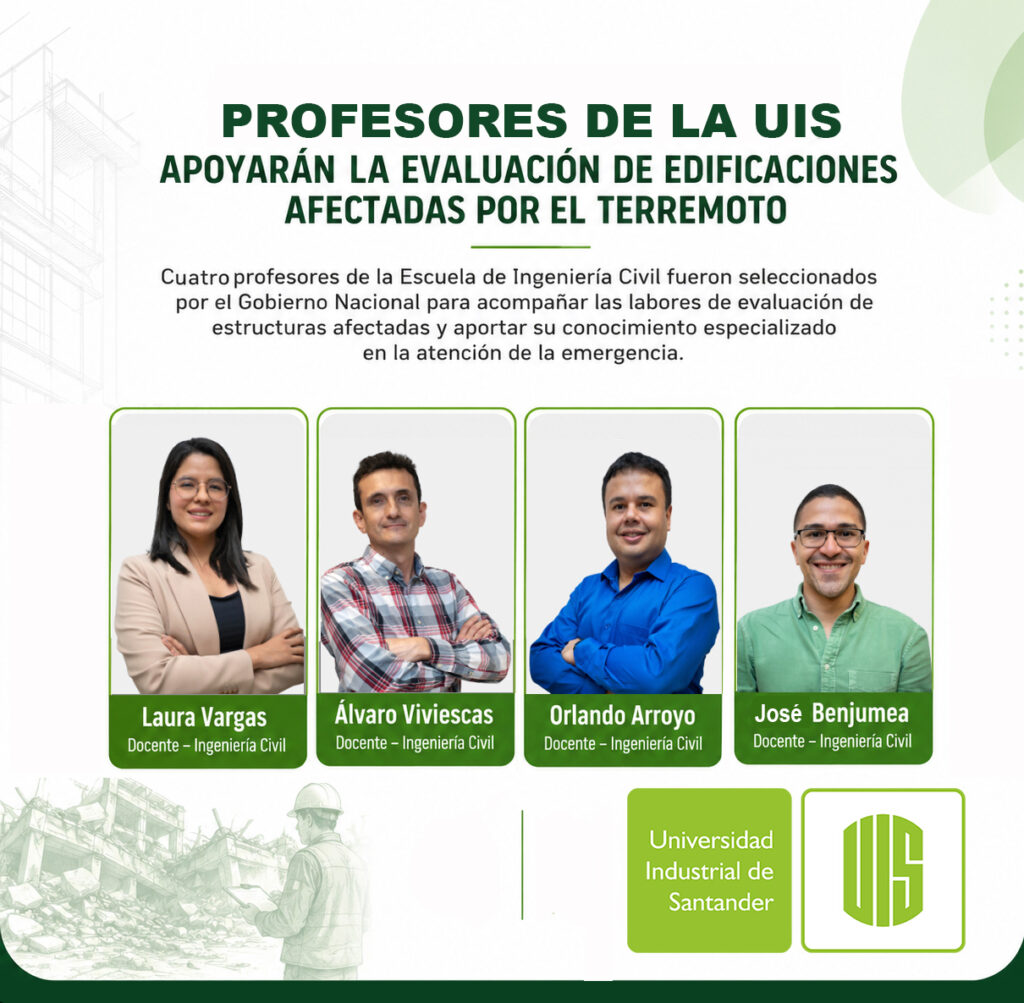
Four professors from the School of Civil Engineering were selected to support the assessment of affected buildings, while the University prepares a team of more than 20 professors and graduates to provide technical assistance in Pereira.
A public university responding to the emergency
As a public university, the Industrial University of Santander (UIS) has made its knowledge, experience, and technical capabilities available to contribute to the response to the communities affected by the earthquake in Pereira.
In response to the Colombian National Government’s call, four professors from the School of Civil Engineering — Laura Vargas, Álvaro Viviescas, Orlando Arroyo, and José Benjumea — were selected to support the assessment of affected buildings and contribute their expertise in structural engineering and seismic risk.
However, UIS’s response to the emergency also includes solidarity and support measures for those affected. The University has established initiatives aimed at providing both financial assistance and academic alternatives for higher education students who have faced the consequences of the earthquake.
One of these measures involves asking UIS employees to donate one day of their salary, with the resources to be allocated, in coordination with the National Government, to support people affected by the disaster.
“The University has adopted several measures. One of them is to ask university employees to donate one day of their salary to support these fellow citizens who have been affected. Once we have the resources, the idea is to allocate them in coordination with the National Government,” explained Hernán Porras Díaz, Rector of UIS.
As a second measure, the University is considering receiving higher education students from the affected areas who have relatives in Bucaramanga, allowing them to continue their academic activities while dealing with the circumstances resulting from the emergency.
“Secondly, there is the option for a student from the higher education sector in the area where the tragedy occurred, who has relatives here, to come and stay with us for a semester or a year, if they consider it appropriate,” said the Rector.
These measures are part of UIS’s institutional response to the emergency and complement the technical assistance that the University will provide in Pereira through its professors, graduate students, and alumni.
More than 20 experts will support the assessment of buildings in Pereira
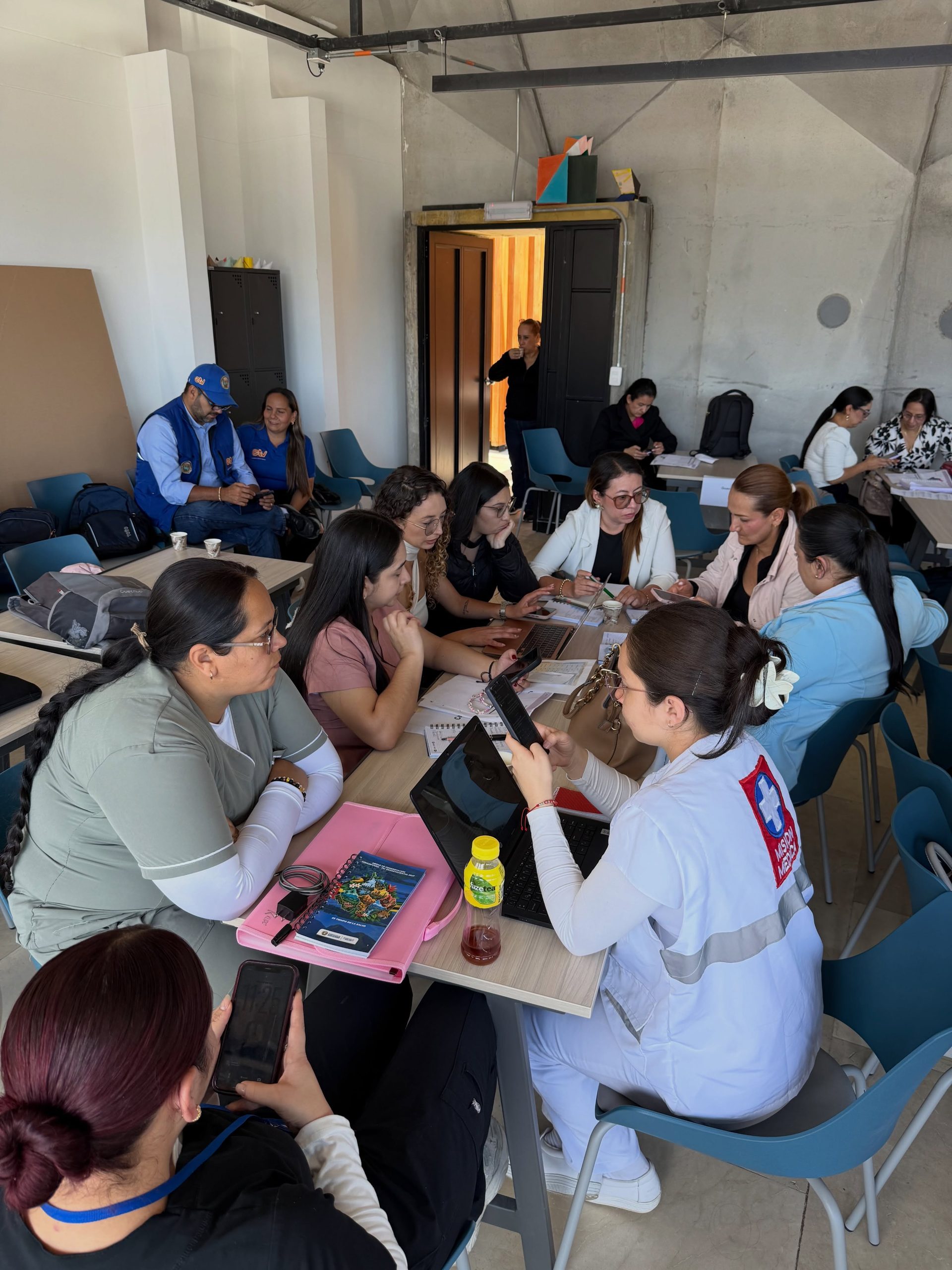
One of UIS’s main actions will be to provide technical assistance in assessing the condition of structures affected in Pereira. For this work, the University, through its School of Civil Engineering and under the coordination of Professor Álvaro Viviescas, is assembling a team of professors, master’s and doctoral students, and graduates of its postgraduate programs.
“Thirdly, we are supporting the assessment of the condition of the structures and buildings in the region. For this purpose, through the School of Civil Engineering, under the coordination of Professor Álvaro Viviescas, we are assembling a group of professors, master’s and doctoral students, and graduates who want to go and help in the area,” explained Porras Díaz.
The Rector indicated that the University expects to assemble a team of more than 20 professors and graduates, who will work in coordination with the institutions responsible for responding to the emergency.
“We believe we can put together a group of a little more than 20 people, including professors and graduates. We are already coordinating with the Ministry of Housing and the National Unit for Disaster Risk Management to determine whether, next week, we can deploy these people to the disaster area,” he added.
The purpose is to support the National Government and local communities in assessing the condition of buildings and determining the state of their structures. This information will subsequently support decisions regarding physical intervention and the assessment of the works required.
From technical inspections to recovery decisions
Assessing a building affected by an earthquake involves a technical process that goes beyond visual inspection. Specialists must analyze the condition of the structure and, when necessary, conduct physical tests to determine the strength and condition of its components.
“There is an entire instrument, a questionnaire, that the engineer conducting the assessment must complete. Following the visual inspection and, in some cases, if necessary, a physical inspection, they can determine for the competent authority whether the building is safe to remain in use, whether it should be reinforced, whether its original condition can be restored, or whether the best option is ultimately to demolish it,” explained the UIS Rector.
When required, professionals may carry out procedures such as extracting concrete cores for laboratory analysis to determine their strength or capacity, as well as examining the condition of the steel reinforcement within the structures.
Once the inspection is completed, engineers must fill out and sign the assessment instrument, which means assuming professional responsibility for the conclusions reached.
For this reason, the Rector highlighted the voluntary nature of the participation of UIS specialists, who will dedicate part of their time to supporting emergency response and recovery efforts in Pereira.
The mission initially involves three- or four-day field visits, with the possibility of additional deployments if the authorities require further technical assistance.
UIS expertise in seismic risk
Professor Orlando Arroyo, leader of the Structural Engineering Group at the School of Civil Engineering, is one of the experts who will participate in this process. His experience combines research in seismic risk, structural assessment, and participation in response processes following seismic events.
During his doctoral studies in Chile, Arroyo served as a scientific coordinator in planning the response to earthquake and tsunami scenarios in Valparaíso and Viña del Mar. In Colombia, he also led a team that developed the National Seismic Risk Model, which assessed seismic risk in 26 municipalities and the seismic vulnerability of structural wall buildings.
His experience also includes participating in building assessments following earthquakes in Chile, knowledge that he now brings to the response in Pereira.
“My specialty is mainly focused on risk, but I have extensive training that allows me to carry out detailed assessments of buildings damaged after earthquakes,” said the professor.
Arroyo was also responsible for providing specific training on the building assessment protocol to postgraduate graduates from UIS who will participate in the mission.
According to Arroyo, distinguishing between a rapid inspection and a detailed assessment is essential in the response following an earthquake. While rapid inspections can be conducted by professionals trained in Civil Engineering or Architecture, including advanced students, detailed assessments require specialists in structural engineering.
“Following an earthquake, there are two types of inspections: a rapid inspection, which can even be carried out by ninth-semester students, Civil Engineering professionals, or architects; and a detailed inspection, which must be conducted by a professional specializing in structures,” said the professor.
In this case, the team made up of professors and postgraduate graduates from UIS will focus precisely on this second stage, aimed at determining in greater depth the safety conditions of affected buildings.
“That is the main need in all the cities at this time: detailed inspections carried out by specialists,” Arroyo emphasized.
Support that will continue beyond the initial emergency response
UIS’s participation is not limited to the initial inspection of structures. The information gathered will support the authorities’ decision-making process and help establish the need for subsequent physical interventions and the assessment of works to be carried out.
Coordination with the Ministry of Housing and the National Unit for Disaster Risk Management will allow the results of the assessments to be incorporated into the process of characterizing, evaluating, and prioritizing buildings requiring intervention.
Transportation and accommodation costs for the professionals will be defined jointly by the University and the National Government.
Through these actions, UIS combines the solidarity of its university community with its academic, scientific, and professional capabilities to support communities affected by the earthquake in Pereira and contribute to the decisions needed to advance the recovery of their homes and infrastructure.