

As part of the objective of Mission-Teaching 2030, a space led by the Academic Vice-Rector’s Office and aimed at the institution’s permanent and visiting professors, in its fifth edition, it focused on “Teaching with meaning, learning with purpose,” that is, it raised awareness about key aspects such as measuring the UIS classroom climate and invisible conditions affecting university learning.
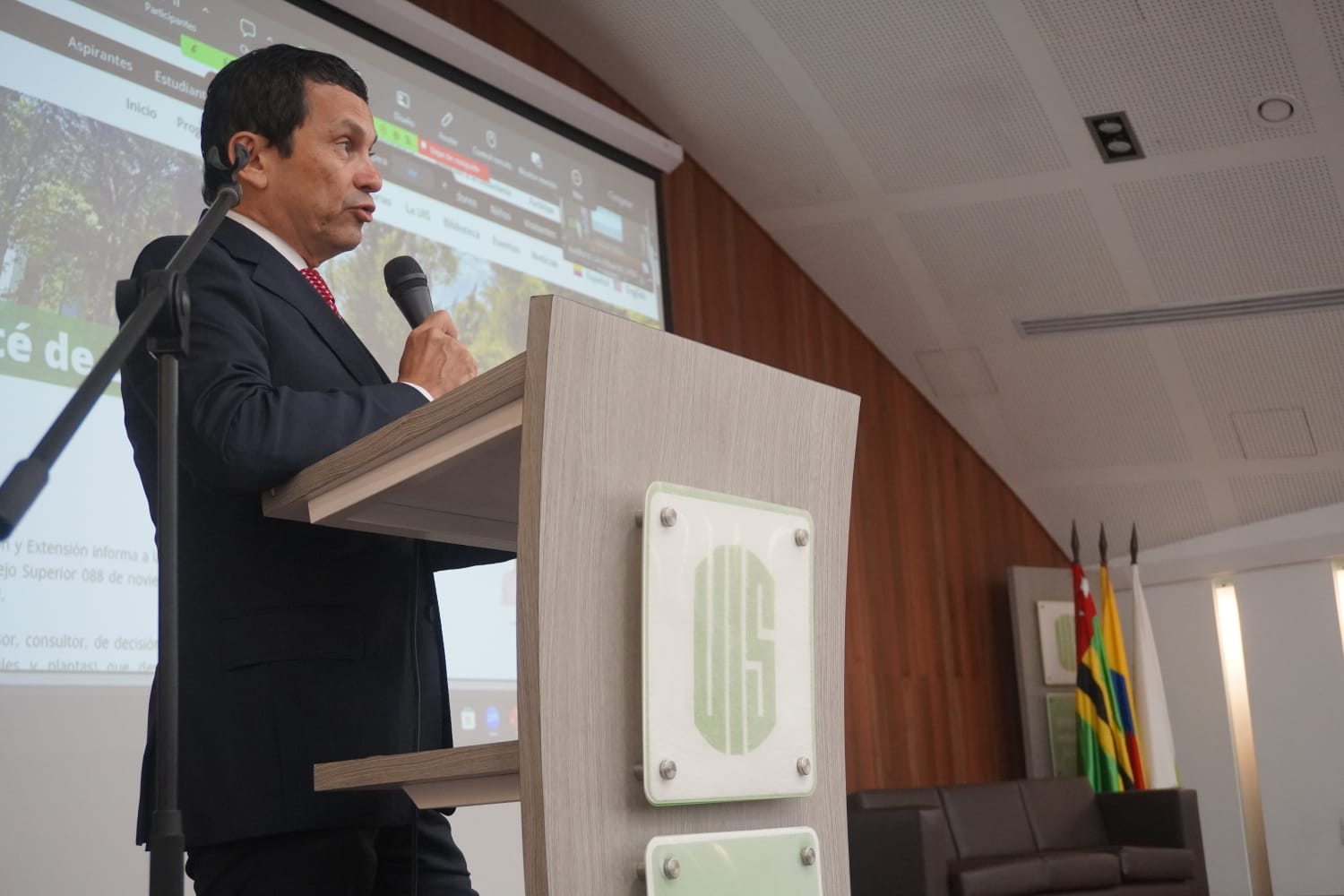
“These pedagogical workshops are a space for reflection and interaction among us professors, in which we will learn new ways of teaching. The institutional pedagogical model “UIS21” is student-centered, that is, focused on the learner, where the professor is no longer the person who simply transmits knowledge from the front of the classroom, but rather the student becomes the builder of their own learning, meaning we become mediators. As this implies a change in our practice and in the paradigm of being a teacher, we need to raise awareness. This leads us to think, rethink, and create more innovative strategies and practices that are closer to the student, so that they can develop autonomy to be the builder of their own learning process,” said Olga Mercedes Álvarez Ojeda, Academic Vice-Rector.
This conference focused on strengthening social-emotional skills, highlighting the impact of “the invisible conditions of university learning,” that is, the “moments of truth” within the classroom, teacher-student interaction, epistemic, social, and interpretive emotions, and the challenge for teachers to understand and manage them.
“When an emotion appears persistently, it is rarely an individual problem; it is usually a symptom of the pedagogical design,” said Rafael Méndez, mathematician and PhD in Experimental, Social, and Mathematical Sciences Education. Professor at the Universidad del Rosario.
The Misión-Docencia team also presented the results of the pilot test to measure the institutional classroom climate, considered by UNESCO to be “a system of shared perceptions between students and teachers.” When applying an instrument to 1,100 UIS students, the response regarding the socio-emotional skills that teachers should have was empathy, at 64%, followed by critical thinking and respect for others.
“The world has changed, and with it, people, profiles, characteristics, culture, and all of this has led to a very strong transformation in the student population. As university professors, we must be at the forefront of these models, because our purpose of educating citizens is closely related to these capabilities and transformations in the world. I think it is very relevant because, in a way, it helps us to see the scenarios that arise in our communities, and especially among our students,” said Luis Eduardo Becerra, Professor at the School of Industrial and Business Studies.
“These spaces are very useful because we are developing our skills with the students. These tools allow us to strengthen processes that we have already been developing and acquire new tools to improve the classroom environment and atmosphere,” said Lili Dayana Becerra, professor at the School of Chemistry.
Transforming the institutional pedagogical model, based on the challenges of higher education and new technological and social realities, creating emotionally safe classroom environments, recognizing that the climate activates the desire to learn, and developing cognitive, interpersonal, and socio-emotional skills involves a process of adaptation and leadership.
The first day ended with a discussion between professors Rafael Méndez, Olga Mercedes Álvarez Ojeda, and Piedad Arenas Díaz regarding teaching processes versus students’ attitudinal responses during the learning process.
Among the messages discussed, the following stand out:
-Spaces of trust must be created so that students feel comfortable expressing themselves.
-Fewer and fewer students are enrolling, and those who do are very young.
-Institutions must have a support system in place to help students deal with complex issues such as suicide.
-Establishing a student mentor figure creates closeness with students.
-The dropout rate among foreign students unfortunately remains high.
-Being “human,” sensitive, vulnerable, fearless teachers who create closeness is a hook for connecting with young people, who come to the classroom not only to learn, but also to be heard, to be human.