

n the foothills of the majestic Sierra Nevada de Santa Marta, where the mountains meet the sky, the children of the Simunurwa Educational Center received a gift that will change their days: a set of musical instruments delivered by the Ministry of Cultures, Arts, and Knowledge through the Arts for Peace Program, operated by the Universidad Industrial de Santander (UIS).
The Sierra Nevada, regarded by Indigenous peoples as the “heart of the world,” preserves an invaluable cultural and spiritual legacy. In this sacred place, knowledge is passed down from generation to generation… every song, every sound, is a dialogue with nature.
Thanks to the Arts for Peace Program, the children and youth of this community now have the opportunity to learn music in a pedagogical space that becomes a bridge between tradition and modernity, between identity and peace.


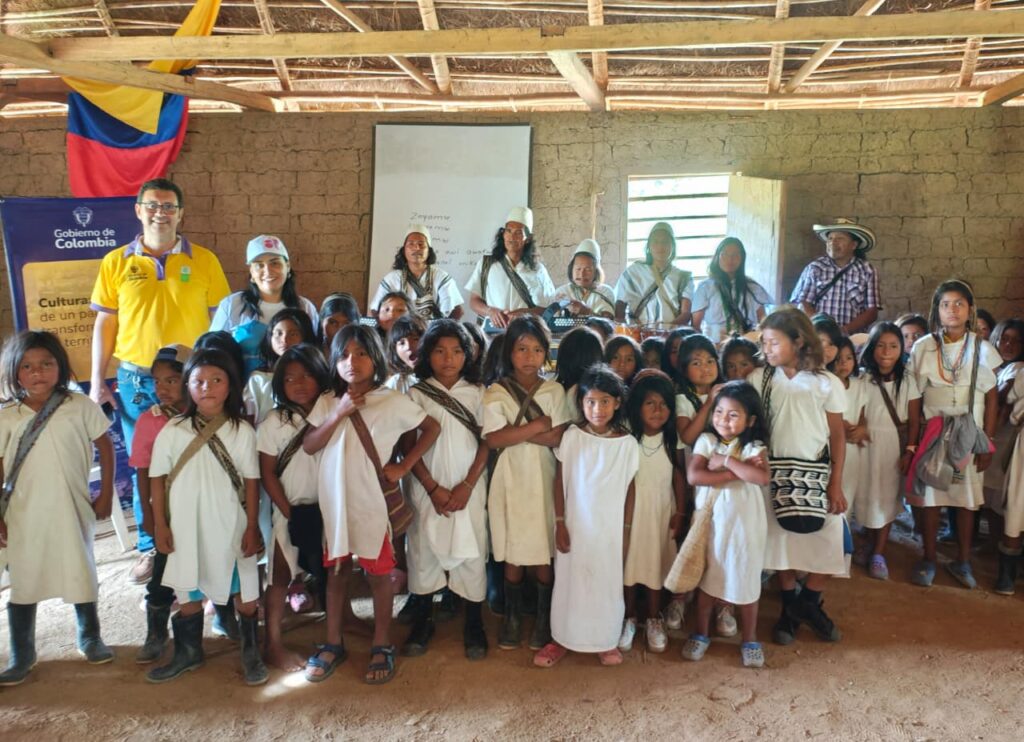
“This is an opportunity to learn about other instruments which, when used properly, can help us preserve or enhance our own. It’s a reciprocal learning process: those who come from outside learn from those within, and those within learn from those outside. The delivery of these instruments has been a great surprise, an unexpected gift that will contribute to improving music education in our school,” said Luis Mestre, principal of the Simunurwa Indigenous Educational Center, with emotion.
At this school, music is not something foreign — it is part of the very essence of the children who grow up surrounded by the natural melodies of their environment. “Our culture naturally loves music. It is the expression of joy and harmony, and guiding it through a pedagogical approach has a great impact on them,” added Professor Mestre with pride.
Meanwhile, parents also view this effort as a seed of transformation. Hugo Jamioy, a resident of the Aty Kwakumuke community and father of a student, expressed his gratitude: “This is an opportunity for our children to develop their abilities and express what they feel through art. Music, dance, theater, writing, or painting allow them to manifest their emotions and build self-confidence. Although the instruments we received are not part of our traditional culture, they inspire great curiosity to learn new things combined with our traditions. The children want to explore the guitar, accordion, or drum, and having an instructor makes this an enormous advantage.”
Beyond filling their days with sounds and melodies, this space helps children make good use of their free time, keeping them away from risks and bringing them closer to art as a way of life and a tool for peace.
“The path we follow begins with the knowledge of our own instruments, such as the carrizo, tambora, and maraca. At first, students feel nervous, but little by little they lose their fear and learn to play and sing in front of their classmates. This new set of instruments is a great beginning — something never seen here before. With it, we can take the first steps toward the kind of music we love, like vallenato,” said Duatukey Torres, a knowledgeable artist from the Program, who led the pedagogical session with students, teaching them both traditional instruments and the newly delivered ones.

The day concluded with an artistic performance filled with smiles and new rhythms that intertwined with the ancestral sounds of the community. It was a reflection of what it means for these children to dream, create, and strengthen their identity through music.
Through this initiative, the Ministry of Cultures and the Universidad Industrial de Santander reaffirm their commitment to reaching the territories of Indigenous peoples, bringing art and culture as tools for building peace. Amid the deep green of the Sierra, the instruments delivered are not just guitars, drums, or accordions — they are keys that open doors to a future where the voices and wisdom of these children will continue to flourish with strength and hope.