

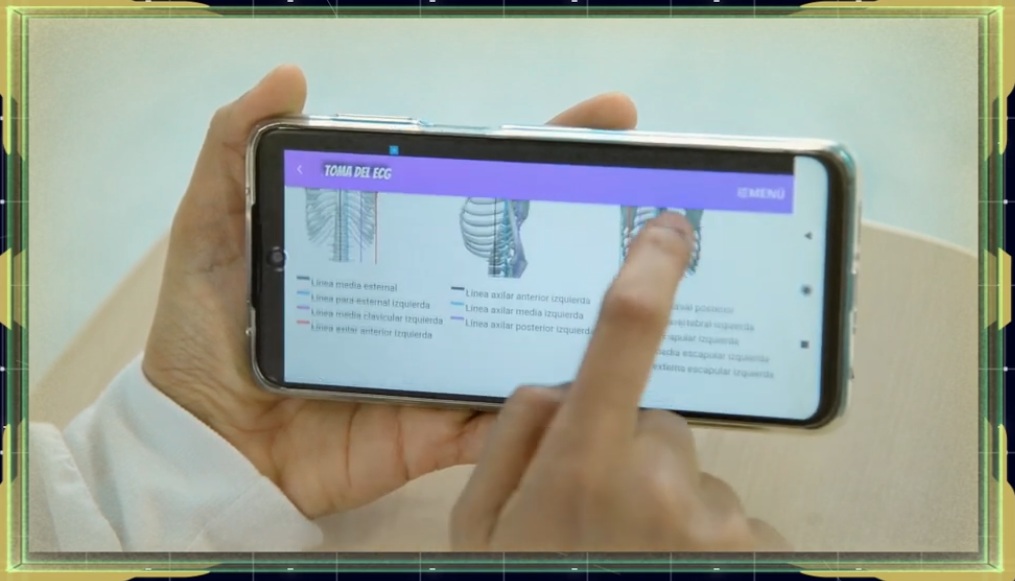
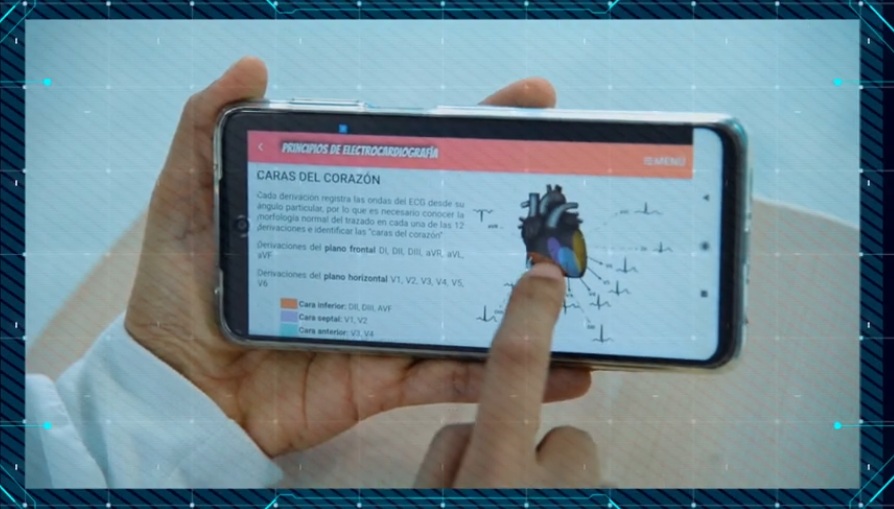
Can you imagine a mobile app that lets you explore the basic principles of electrocardiography, the technical aspects of taking an electrocardiogram, basic interpretation, and arrhythmias?
“ECG for Nursing” was created for this purpose—an app where users can explore the content independently, select topics of interest, and mark them as favorites for quicker access later.
According to Professor Judy Ximena Ramos, the app’s creator, one of the tool’s distinguishing features is the way it presents arrhythmias. The electrocardiogram tracings are accompanied by explanations of their main characteristics, with graphical elements that allow students to visually identify what they need to recognize.
“This app was an idea that came about during the pandemic, as we sought to provide students with more educational content on a topic they find particularly challenging: learning electrocardiography. Electrocardiography involves a lot of numerical data that’s hard for them to memorize, as well as a large number of images they have to memorize and become familiar with, so we started creating highly educational and pedagogical content for the classes. Then the call for proposals for Innova TIC 2020 was announced; we participated and won the grant to create an app. That’s where the idea came from,” says Judy Ximena Ramos, a professor from the UIS School of Nursing.
But the app goes beyond displaying static images. It features a heart rate simulator that displays moving waveforms, similar to those seen on an intensive care unit monitor.
This feature is designed to strengthen what is known as visual memory: students can observe different heart rhythms, become familiar with them, and then test their knowledge through a self-assessment mode.
In the self-assessment, the rhythms appear randomly, and the user must identify which one they are observing. Upon completion, the app provides feedback to acknowledge correct answers and identify which content requires further review.
The tool also includes information on heart rate and the sounds associated with an electrocardiogram monitor—elements that bring the learning experience closer to situations that may be encountered in clinical settings.
A Tool for Studying
Another noteworthy feature relates to treatment algorithms for arrhythmias. The app presents organized information on the interventions to consider for specific rhythms, including pharmacological aspects and, when applicable, information regarding the use of electrical shocks.
In this way, the resource is not limited to visual recognition of the waveform but integrates various elements that allow students to connect heart rate, its characteristics, and the actions that are part of the clinical approach.
The structure aims to transform content that can traditionally be complex—due to the amount of information students must memorize—into a more dynamic and organized learning experience.
As Ramos explains, there is a study module and a simulation module. The study modules are designed specifically to help students review the content, since it involves a lot of numbers and very precise data; then there is the rhythm simulator, which displays electrocardiogram tracings in real time, just as they would appear on an actual monitor in an intensive care unit, for example. “They log in, view the different rhythms, and then the app also allows them to take a self-test. So they select self-test mode, and the app randomly displays the different rhythms; they must try to identify which rhythm is shown, which helps them exercise their visual memory.”
An Updated Version
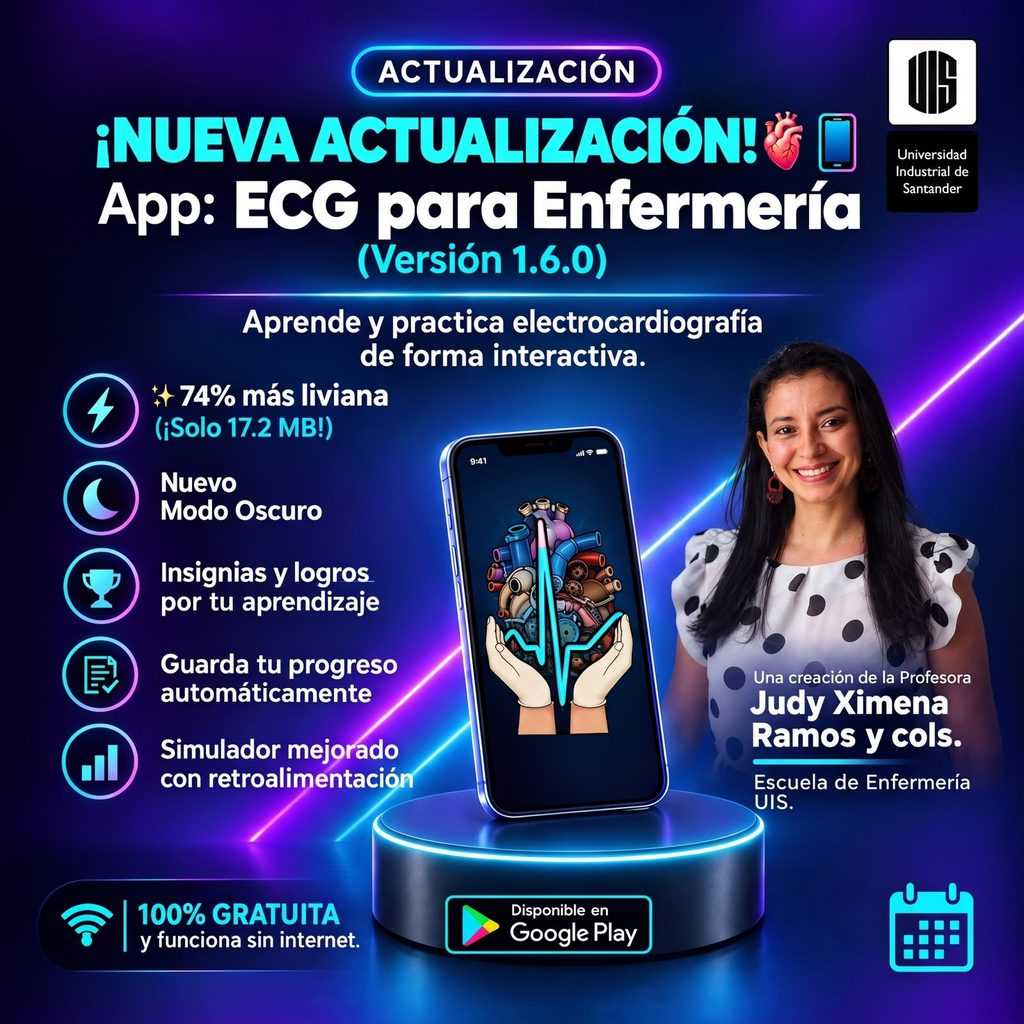
The app continues to evolve with the release of version 1.6.0, which includes improvements aimed at enhancing performance, navigation, and the learning experience.
Among the new features of “ECG for Nursing” is a global search function that allows users to quickly locate the 33 learning topics and 15 arrhythmias available. The app also now allows users to resume modules from where they left off, eliminating the need to start each module from the beginning.
The new version also allows users to track their progress by highlighting topics they’ve already covered and displaying a progress bar. In addition, badges and achievements have been added to recognize users’ progress throughout their learning journey and their ability to identify arrhythmias.
The rhythm simulator has also been improved. It now offers a more comprehensive self-assessment experience and includes feedback on which rhythms require further review, along with the correct answer.
User experience improvements also include the addition of dark mode, available throughout the app, as well as adjustments to facilitate viewing and navigation on different screen sizes. Issues related to the simulator’s audio and other bugs detected in the previous version have also been fixed.
One of the most significant changes—especially for those with limited storage or internet connectivity—is the app’s size. The download size has gone from 66.8 MB to 17.2 MB, representing an approximate 74% reduction.
An App That Has Expanded Its Audience
Although the project was initially designed for nursing students, its use has shown that the need for educational tools to learn electrocardiography extends beyond a single discipline.
Students in various health sciences programs and professionals in the field have found the app to be a valuable resource for studying, reviewing, and testing their knowledge. Even technical staff, such as nursing assistants, can use it as a reference and learning tool.
This broad reach highlights one of the possibilities offered by digital technologies applied to education: transforming specialized content into accessible, visual, and interactive learning experiences capable of supporting both academic training and continuing education for those already practicing in the healthcare field.
Thus, an initiative that emerged during a time marked by pandemic restrictions found in technology an opportunity to transform the way a fundamental topic in health care is approached.
In that sense, “ECG for Nursing” represents the evolution of a teaching strategy that originated in the classroom into a digital tool that allows users to study electrocardiography, observe rhythms in real time, assess their own progress, and track their learning from a mobile device.