

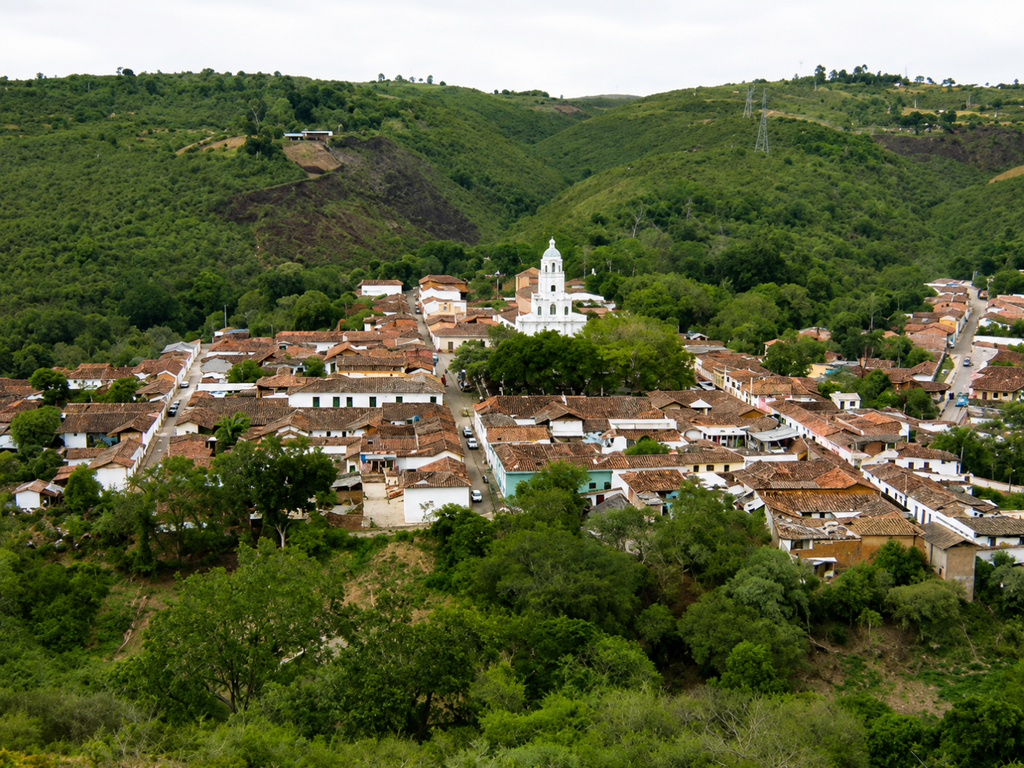
Santander is home to one of the most remarkable seismic phenomena on the planet. Beneath the surface, at a depth of approximately 140 kilometers, lies the Bucaramanga Seismic Nest, a concentration of intermediate-depth earthquakes characterized by its persistent activity, relatively small size, and ability to generate earthquakes of moderate magnitude.
A study conducted by the Universidad Industrial de Santander (UIS) provides new evidence to help explain why so many earthquakes repeatedly occur at this particular location beneath Santander.
The research was conducted by Carlos A. Vergara, a graduate of UIS’s Master’s Program in Geophysics; Manuel A. Flórez, professor at the UIS School of Physics; and Germán Prieto, professor at the Universidad Nacional de Colombia, Bogotá campus. The researchers analyzed six years of records involving more than 32,000 earthquakes, using their distribution and locations as an indirect map to reconstruct the shape of the tectonic plate beneath northwestern South America.
Into the Depths of the Earth
The Bucaramanga Seismic Nest is known as one of the most active concentrations of intermediate-depth earthquakes in the world. Its behavior is exceptional: earthquakes occur continuously within a relatively small area and at depths that make it impossible to directly observe the geological structures responsible for this activity.
In fact, the researchers note that only two other comparable seismic nests have been identified on the planet: one beneath Romania and another beneath Afghanistan.
For decades, the scientific community has sought to explain why Bucaramanga experiences such a concentrated level of seismic activity. The UIS research provides new evidence pointing to the complex geometry of the tectonic plate that subducts beneath this region.
Tectonic plates do not necessarily descend into the Earth as completely flat and rigid structures. During subduction processes, a plate can bend, change direction, and deform as it moves to greater depths.
In this study, the researchers found evidence that the plate beneath Santander undergoes significant changes in geometry in the vicinity of the Bucaramanga Seismic Nest.
“Markers” of the Plate
Because scientists cannot directly observe a structure located more than 100 kilometers beneath the surface, earthquakes become a fundamental tool for studying what happens at these depths.
In this case, the researchers precisely determined the locations of more than 32,000 earthquakes recorded over a six-year period, from 2016 to 2021. The distribution of these events made it possible to indirectly reconstruct the geometry of the tectonic plate subducting beneath northwestern South America.
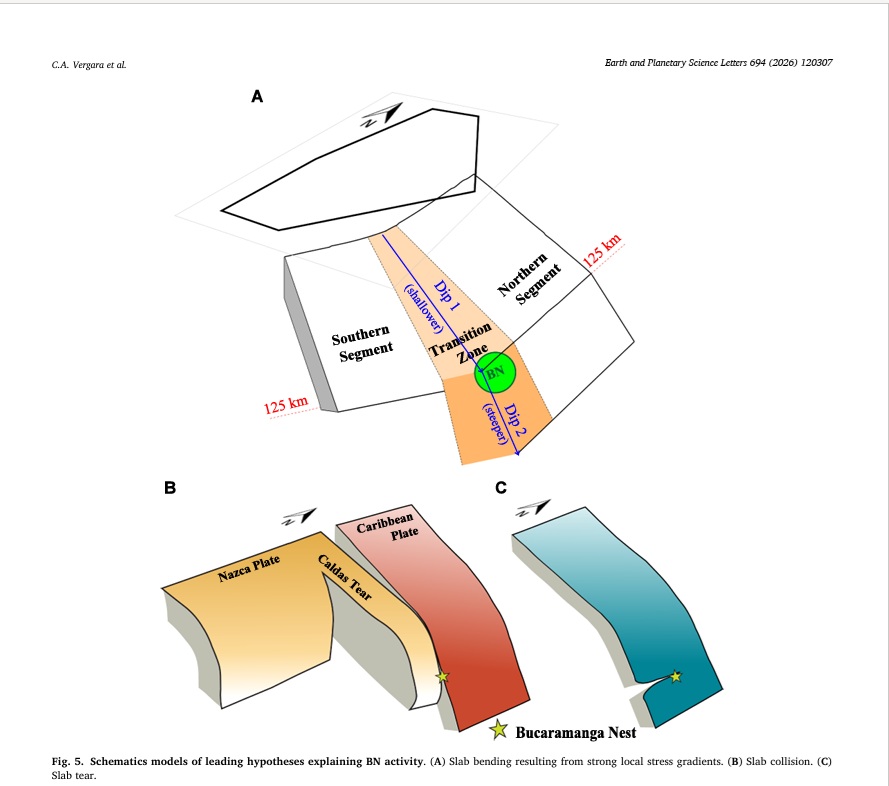
The results reveal a complex structure consisting of two major plate segments. Near the seismic nest, the plate changes its horizontal direction and, beginning at a depth of approximately 125 kilometers, develops a considerably steeper inclination.
The Bucaramanga Seismic Nest is located precisely within this transition zone, where the plate would undergo deformation in different directions.
According to the researchers, this particular configuration could explain, at least in part, the concentration of stresses within the plate and, consequently, the persistent seismic activity in this region.
A Structure That Deforms and Concentrates Stress
The study’s main interpretation is that the unusual geometry of the tectonic plate creates conditions capable of concentrating stress within it.
The phenomenon can be understood through a simple analogy: a structure that is sinking while simultaneously having to change direction and increase its inclination may experience greater deformation in the areas where these changes occur.
From this perspective, the Bucaramanga Seismic Nest would be located in a particularly complex section of the plate, where changes in its geometry could favor the concentration of stress and the recurrent generation of earthquakes.
The distribution of earthquakes also provides relevant information. According to the findings, seismic activity shows continuity and does not exhibit the large displacement that would be expected if the plate were completely torn apart or if there were a clearly defined collision between two different plates.
This supports the interpretation that the activity of the seismic nest may be related to the three-dimensional deformation and bending of the tectonic plate rather than to a complete rupture of the structure.
A Regional Phenomenon
The research also offers a broader perspective on the phenomenon. The Bucaramanga Seismic Nest may not necessarily be an entirely isolated geological anomaly.
The researchers identified five major concentrations of intermediate-depth earthquakes within the regional subduction system, including the Bucaramanga Seismic Nest itself.
Although the other clusters are smaller and exhibit less intense seismic activity, their presence suggests a possible relationship between the concentration of earthquakes and changes in the geometry of the subducting plate.
In this way, the Bucaramanga Seismic Nest could represent the most active and evident manifestation of a tectonic process taking place on a regional scale.