
When we think of a mathematician, it is easy to imagine someone in front of a blackboard, filling in equations with white chalk, the old-fashioned way. For many, that has been the mold, the only visible path. But mathematics, like life itself, does not fit into a single formula. It is universal, as broad as the dreams of those who embrace it.
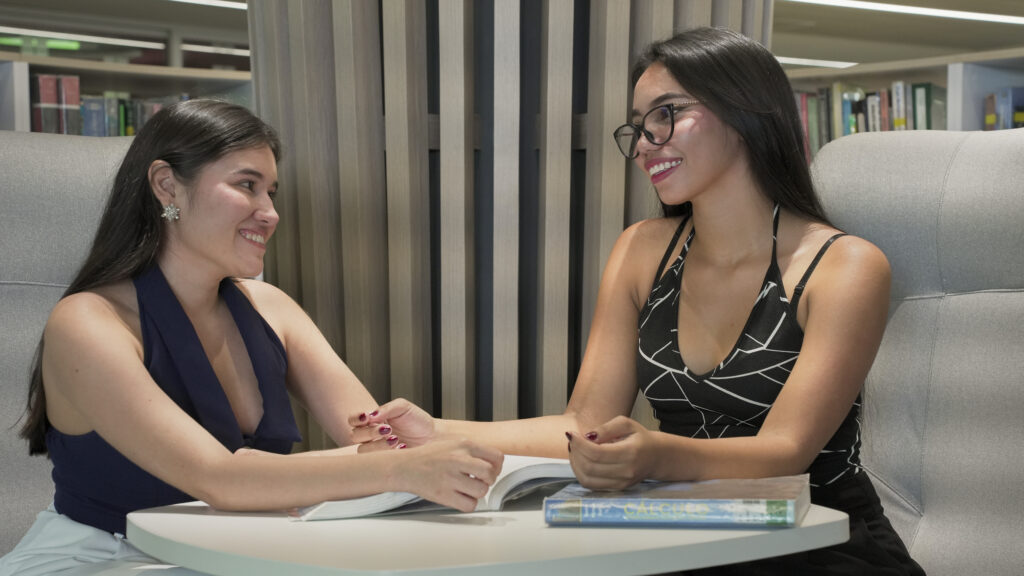
Keren Slendy Rodríguez and Catalina Ballesteros, Mathematics students at UIS, are an example of this. They show us that mathematics is not only taught: it is also applied, lived and transformed. In their voices resounds an urgent truth: mathematicians have much more to teach, they have everything to create. Beyond numbers, problems, equations?
Keren, with enthusiasm, recalls how she dared to cross a threshold that many would consider alien: “I asked my professor if there was a possibility that I, as a mathematics student, could do a business internship and he encouraged me and told me that it was possible”. What started as a consultation ended up becoming a mission: to apply advanced mathematical tools in patient segmentation to improve clinical care at the FOSCAL Clinic in Floridablanca. Keren works in the area of Costs and Financial Planning, and Catalina is working in the Biomedical area.
There, among figures and models, Keren saw how her discipline could touch real lives: “I am applying statistics and data analysis in patient segmentation… I could also apply other important algorithms, decision trees, random forest, neural networks… to make better medical and administrative decisions”.
And it was there that a doctor, an eminence in ophthalmology, upon seeing her arrive with her knowledge as a mathematics student, exclaimed with hope: “I need more mathematicians in my team… I need them to correct me and contribute to me in the area of mathematics”. Because even the health of the eyes can benefit from a logical mind, trained to solve problems.


Catalina, for her part, testifies to the power of mathematics to form not only brains, but character: “the career not only teaches us numbers, but also teaches us a lot about perseverance, self-study, research and losing the fear of giving up”. In her words, there is pride and also challenge, because she herself overcame the prejudice of feeling out of place in a hospital: “I could be afraid and say: I am a mathematician, I have no reason to be in the health field… but mathematics is everywhere”.
And yes, it is. In the models that predict diseases, in the algorithms that detect tumors, in the graphs that guide political decisions. Catalina recalls it clearly when talking about the pandemic: “mathematical models were also needed precisely to estimate the peak of those infected at the time of the Covid-19 pandemic”.
Both invite us, with the strength of their testimony, to break the mold. To look with new eyes at a career in mathematics. “When we say we study mathematics, people always look with admiration and awe… then the next question is, that’s only good for being a teacher, right? And it’s a very common thought, but not very correct,” Keren clarifies.
“The invitation is that mathematics is not only for teaching, it is for creating and that they are encouraged to create the world they want to live in,” she says, with a vision of the future. And Catalina reaffirms: “we cannot only focus on teaching… we have much to contribute to the world, in medicine, in architecture, in technology…”.
Today more than ever, we need minds that combine rigor with imagination, logic with heart. Mathematics is not just a set of abstract rules; it is a key that can open doors to more just, efficient and humane realities.
So, if you are hesitating which path to take, listen to these voices. Dare to see mathematics not as a single destination, but as a map with infinite routes. Because behind every technological breakthrough, every more precise diagnosis, every innovative solution… is the mind of a mathematician… And perhaps, the next one will be you.