
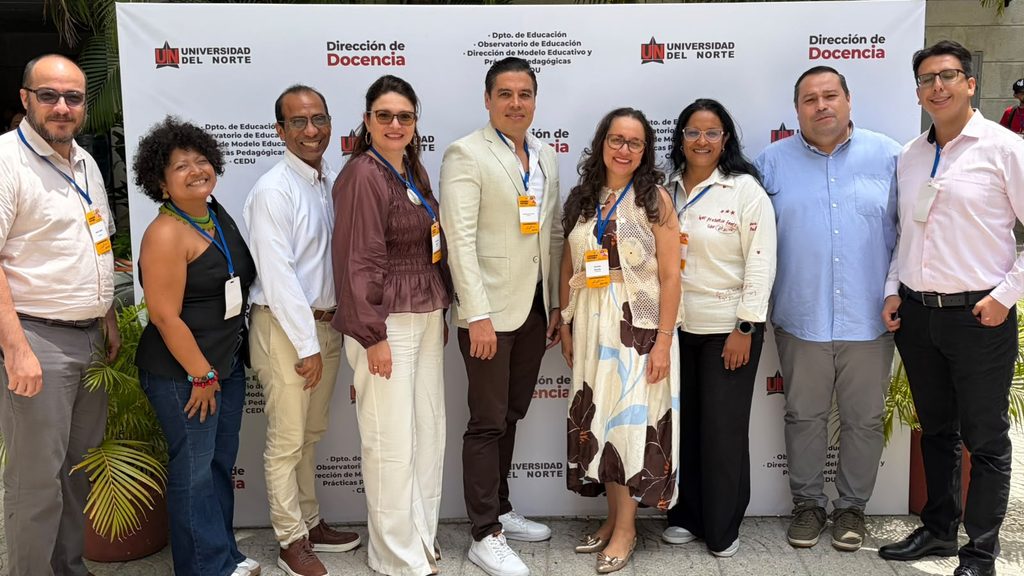
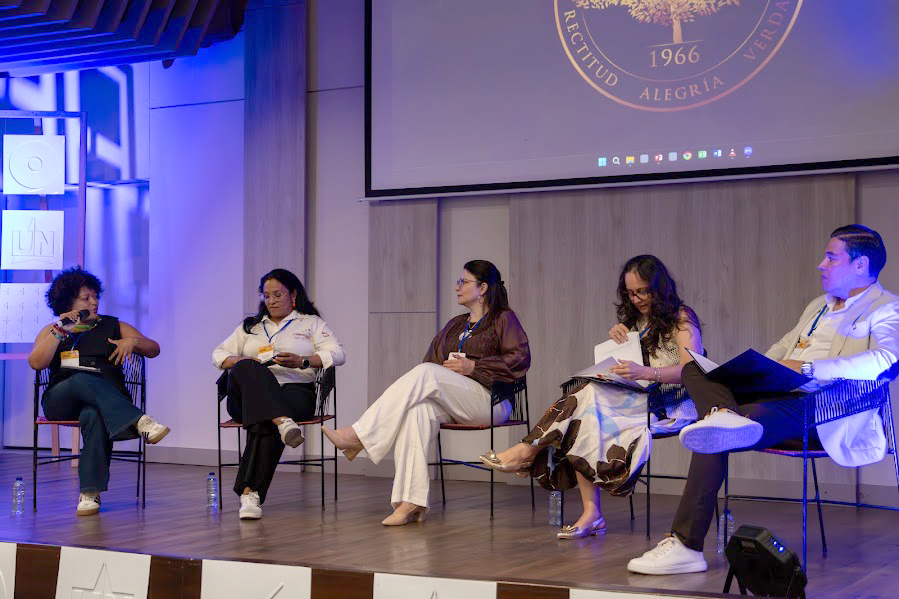
Professor and CEDEDUIS Director Hernando Guerrero participated as a speaker at the 19th Symposium “Societies Facing the Digital Challenge: Transformations and Challenges in Higher Education,” held on October 1 in Barranquilla.
The Universidad Industrial de Santander (UIS) shared its experience in the digital transformation of higher education during the 19th Symposium “Societies Facing the Digital Challenge: Transformations and Challenges in Higher Education,” a space for academic dialogue on the changes and challenges facing university education in technology-mediated environments.
Representing UIS, Professor and Director of the Center for the Development of Teaching at UIS (CEDEDUIS), Hernando Guerrero, participated as a speaker at the event, held on October 1 in Barranquilla as part of Cátedra Europa, an institutional program of Universidad del Norte that promotes academic and cultural exchange between the Colombian Caribbean and the European academic community.
His participation provided an opportunity to share the experience UIS has developed in incorporating information and communication technologies into educational processes, as well as the pedagogical challenges that accompany this transformation.
Technology in the service of learning
UIS began its path toward the digital transformation of learning before the pandemic, through a policy supporting education with information and communication technologies and strategies aimed at accompanying faculty members.
The health emergency accelerated the incorporation of virtual learning environments into higher education. However, according to Hernando Guerrero, the subsequent challenge has been to move beyond the instrumental use of these tools and give them genuine pedagogical meaning.
“Since then, the challenge has been to give them a pedagogical purpose: to facilitate student participation, support and learning,” Guerrero explained.
This perspective focuses not only on the availability of technological tools, but also on how they can contribute to educational objectives. For Guerrero, technology becomes meaningful when it creates better opportunities for students to participate, reflect and apply what they have learned.

The teaching role is also changing
Digital environments have created new possibilities for educational processes while also transforming the way professors carry out their work.
According to Guerrero, virtual learning requires clearer planning of activities, interaction and feedback. At the same time, it offers new ways to present content and monitor students’ progress.
This process also requires recognizing students’ different conditions of access and avoiding an overload of assignments. In this context, professors continue to play a fundamental role as guides of the educational process.
“The professor remains the person who gives educational meaning to the tools,” said the CEDEDUIS Director.
Preserving the human dimension in digital environments
One of the challenges of technology-mediated education is maintaining close communication with students and recognizing their needs throughout the learning process.
For Guerrero, this requires clear instructions, opportunities for students to ask questions and feedback that helps them move forward. It also means identifying when a student needs support and creating spaces for conversation.
In this regard, the support provided to professors and the teaching-learning communities developed at UIS contribute to strengthening the relationships that make it possible to preserve the human dimension of education, even in digital environments.
Meaningful learning beyond the technology
UIS’s participation also contributed to the discussion about what makes a virtual learning experience meaningful. For Guerrero, the starting point is to establish clearly what students are expected to learn and design activities that allow them to participate, think and apply their knowledge.
Digital resources should be accessible and accompanied by interaction and feedback. Their value, he explained, lies not simply in the technology itself, but in the learning opportunities they make possible.
Through its participation in Cátedra Europa, UIS shared its experience and perspectives on the digital transformation of higher education, highlighting technology as a resource for strengthening teaching while keeping professors’ role and students’ needs at the center of the educational process.