
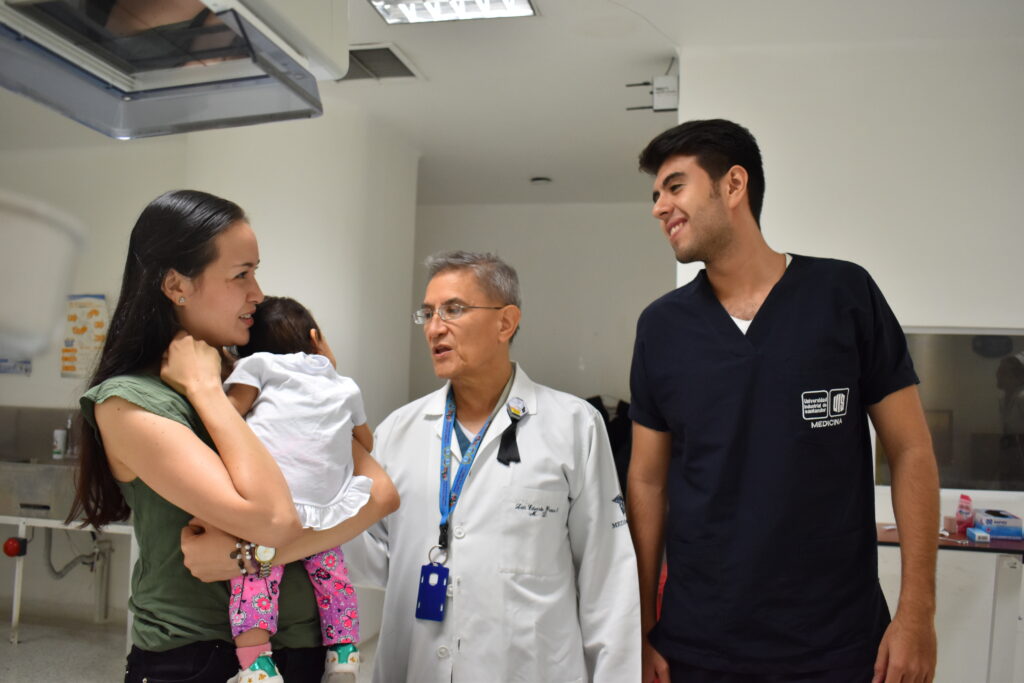
The Industrial University of Santander has good news for the department. Its primary clinical training site for students in the School of Health has achieved one of the most important recognitions in the areas of quality of care, teaching, and research.
Through Agreement No. 012 of July 22, 2026, the Intersectoral Commission for Human Resources in Health granted the University Hospital of Santander recognition as a University Hospital, valid for seven (7) years.
This significant achievement fills Santander with pride and strengthens the HUS’s mission as a leading institution in the training of healthcare professionals. Furthermore, it makes it the 33rd University Hospital in the country and the sixth public institution in Colombia to receive this distinction, after meeting the 44 criteria established by current regulations.
This new institutional milestone recognizes excellence in patient care, teaching, and research, consolidating the Santander University Hospital as a benchmark for the training of healthcare professionals and for the provision of high-quality services that benefit the Santander community and the entire region.
“The UIS has been a key player in this process. This recognition is the result of the commitment, coordinated efforts, and joint work of both institutions to achieve the distinction of being a University Hospital—an accomplishment that will undoubtedly translate into greater benefits for the health of the people of Santander and for the training of future professionals in the field,” said Professor Jürg Niederbacher Velásquez, dean of the School of Health at the Industrial University of Santander.
Historical Context
In 2005, the Santander University Hospital (HUS) was established by departmental ordinance as a public institution under departmental jurisdiction and the main hub of the network providing medium- and high-complexity health services in northeastern Colombia.
Since its creation 21 years ago, the HUS has remained steadfast in its goal of achieving recognition as a university hospital. However, this journey has been marked by numerous challenges and circumstances that have hindered the achievement of this important objective. Over the past decade, the institution has worked tirelessly and with unwavering commitment to make this dream a reality.
One of the most significant milestones was reached in 2024, when the hospital obtained quality certification for its health services. It also incorporated into its strategic objectives the strengthening of teaching and research—fundamental pillars for its institutional development—in which the Industrial University of Santander has played a decisive and highly impactful role.
UIS Support
In this important process, the School of Health at the Industrial University of Santander, as the primary academic and training setting within the Santander University Hospital, has played a fundamental role. Its ongoing support, the strengthening of training, research, and outreach processes, as well as the shared commitment to academic and clinical excellence, have been decisive in establishing the conditions that today enable the HUS to move toward recognition as a university hospital.
Similarly, the Industrial University of Santander has resolutely supported this process by allocating resources, providing highly qualified personnel, and facilitating institutional coordination led by UIS faculty members across the five strategic sub-departments. This comprehensive support has made it possible to strengthen academic, patient care, administrative, and research processes, thereby consolidating an inter-institutional relationship aimed at meeting the standards required for the recognition of the Santander University Hospital as a university hospital.
“As students, this recognition represents a historic achievement for our academic and professional training. Having a strengthened university hospital provides us with greater opportunities for learning, research, and growth in real-world healthcare settings. It is a source of pride to see how the coordinated efforts between the hospital and the university are now bearing fruit that will benefit not only future generations of professionals but also the entire community,” said Danna Pardo Medina, a student of Microbiology and Bioanalysis.
Timeline
*In September 2022, the HUS received certification from the Global Network of Green and Healthy Hospitals. This certification makes ESE HUS one of 1,600 members representing more than 60,000 hospitals and health centers in 78 countries, all dedicated to reducing the sector’s environmental footprint and promoting public health.
*Since 2023, HUS has held the “non-discrimination seal” certification, granted by ICONTEC on behalf of the Ministry of the Interior.
*In February 2024, the ESE Hospital Universitario de Santander obtained health accreditation granted by the Colombian Institute of Technical Standards and Certification (ICONTEC). This achievement positions HUS as one of 65 healthcare providers in the country and the first public hospital in northeastern Colombia to receive this recognition.
*In October 2024, the HUS incorporated the Deputy Directorate of Teaching and Research Management into its organizational structure, led by nurse Marisela Márquez, a professor affiliated with the School of Nursing.
*In March 2025, for the first time, ESE HUS was included in the “World’s Best Hospitals 2025” ranking published by Newsweek, placing among the top 60 hospitals in Colombia. This list highlights the most outstanding hospitals in 30 countries, evaluating their quality, technology, and patient care.
*In October 2025, the Blood Bank of the Santander Blood Center (ESE HUS) received Category A certification from INVIMA, the highest possible classification. This certification recognizes compliance with the highest standards of quality, safety, and best practices in the collection and handling of blood components at the department’s only public blood bank.
*In 2025, the HUS achieved certification as a “Risk-Free Hospital” (fiscal and financial), in accordance with Resolution 1122 of 2025.
*In 2026, ESE HUS was recognized among the “Global Top 250 Hospitals 2026 – Ranking the Most Reputable Academic Medical Centers” according to the World’s Top AMCs ranking. This international recognition highlights leading university hospitals for their excellence in patient care and medical research.
*In April 2026, ESE HUS received a visit from the INVIMA institute as part of the evaluation process for Good Clinical Practice (GCP) certification of Clinical Trial Centers. Obtaining this certification is a key step that reflects the commitment of the departmental government and the institution to excellence, research, and the strengthening of high-quality health care.
*On April 30, 2026, the HUS received its first follow-up visit from ICONTEC, exceeding the score from the previous evaluation (2024).
*As of May 2026, the HUS has various services available within its installed capacity: 349 inpatient beds, 8 operating rooms, 15 chemotherapy chairs, 25 outpatient clinics, 137 observation beds, 18 procedure rooms, 3 fully equipped ambulances, 4 rehabilitation unit clinics, 1 delivery room, 2 radiation therapy rooms, and 7 emergency rooms.
As of July 2026, ESE HUS received recognition from INVIMA for Good Manufacturing Practices for Medical Gases.
“Although the institution has borne the name ‘University Hospital’ since 2005, today we officially received recognition as a university hospital. We have become the 33rd hospital in the country—among both public and private institutions—to achieve this distinction, which represents a significant strengthening of our teaching and research processes and is a source of pride for our entire institution,” said TC Ricardo Hoyos, manager of the HUS.
Outreach Strategies That Make an Impact on the Community
*The HUS operates 15 radio programs (National Army Radio Station 92.9 FM)
*Wisconsin Medical Mission (39 years serving the community)
*Suicide prevention and awareness in schools
*Continuing education (symposia, forums, workshops; 3,555 participants)
*Partnership with Fundación Éxito (2,440 children benefiting from nutrition programs)
*Agreement with ICBF (1,200 families impacted across 27 municipalities)
What does it take to be a university hospital?
In Colombia, for a private healthcare provider (IPS) to be recognized as a university hospital, the primary regulations are Law 1438 of 2011 and Resolution 3409 of 2012 issued by the Ministry of Health. The regulations establish six major requirements, but the verification and accreditation processes break these down into multiple technical criteria.
According to the Intersectoral Commission for Human Resources in Health (CITHS), the Ministry of Health and Social Protection, and the Ministry of National Education, 44 criteria must be met to be recognized as a university hospital.
44 Criteria for Evaluating a University Hospital
- Institutional Licensing and Accreditation
- Hold a valid license for health services.
- Hold valid health accreditation.
- Comply with the standards of the Mandatory Quality Assurance System.
- Conduct internal quality audits.
- Have patient safety indicators in place.
- Have continuous improvement plans in place.
- Teaching-Service Relationship
- Have valid teaching-service agreements in place.
- Agreements with legally recognized universities.
- High-quality accredited academic programs.
- Existence of a teaching-service committee.
- Periodic evaluation of the agreements.
- Joint participation between the IPS and the university.
- Clear definition of academic responsibilities.
- Evidence of monitoring students during clinical rotations.
- Clinical Settings and Teaching Capacity
- Sufficient clinical services for training.
- Appropriate settings for undergraduate students.
- Appropriate settings for graduate students.
- Structured clinical rotations.
- Formal scheduling of clinical rotations.
- Appropriate student-to-faculty ratio.
- Appropriate student-to-patient ratio.
- Availability of physical teaching spaces.
- Availability of simulation rooms or academic support facilities.
- Availability of libraries or scientific databases.
- Facility capacity commensurate with the number of students.
- Integration of patient care, teaching, and research
- Inclusion of teaching in the institutional strategic plan.
- Integrated processes between clinical care and academia.
- Student participation in supervised clinical activities.
- Ethical protocols for training practices.
- Existence of scientific and academic committees.
- Research
- Research group recognized by Minciencias.
- Demonstrable scientific output.
- Regular scientific publications.
- Participation in research networks.
- Active research projects.
- National or international recognition in research.
- Student participation in research.
- Research training for students.
- Institutional scientific outreach channels.
- Faculty
- Faculty members with graduate-level training.
- Faculty members with certified academic experience.
- Researchers with formal affiliation.
- Dedicated time for teaching and research activities.