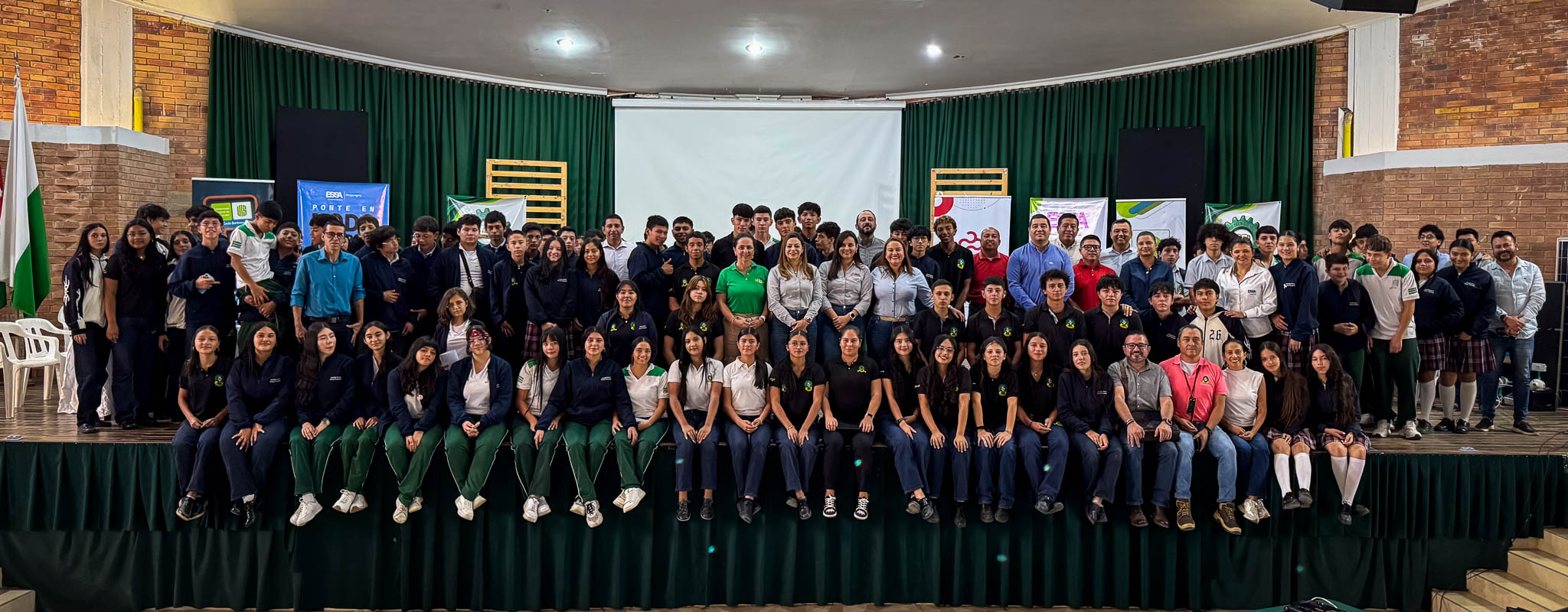


To bring emerging technologies into technical education and expand learning opportunities for young people across Santander, Universidad Industrial de Santander (UIS), Electrificadora de Santander (ESSA), and the Bucaramanga Chamber of Commerce (CCB) have launched the third phase of their cooperation agreement. The initiative aims to strengthen the skills and competencies of teachers and students specializing in electricity.
This phase will benefit two educational institutions: Instituto Técnico Industrial Francisco de Paula Santander, located in Puente Nacional, and Instituto Técnico Aquileo Parra (ITAP), in Barichara. Both schools will participate in a comprehensive initiative to enhance their educational and technological capabilities, better aligning students’ training with labor market demands and opportunities for higher education.
The initiative represents a joint investment of COP 1,098,299,700 and will be implemented over 21 months. Planned activities include institutional needs assessments, the design and manufacture of laboratory workstations, the development of educational materials, and specialized professional development for teachers.
Technology and Education as Drivers of Regional Development

The agreement builds on a collaborative relationship that the participating organizations have strengthened over the past five years, with the shared goal of improving technical education throughout the region.
Luis Eduardo Bautista, director of the UIS School of Industrial Design, explained that the initiative seeks to equip educational institutions with the technology and learning resources needed to modernize their electrical laboratories.
“This project is part of a partnership that has been developing over the past five years among Electrificadora de Santander, the Bucaramanga Chamber of Commerce, and the Schools of Industrial Design and Electrical, Electronics, and Telecommunications Engineering,” he stated.
According to Professor Bautista, one of the initiative’s key strengths is its tailored approach. Laboratory equipment and learning environments will be designed to meet the specific needs of each school, taking into account students’ abilities, institutional resources, and technological advances in electricity and electronics.
To achieve this, the project team will follow a human-centered design methodology consisting of five stages: empathize, define, ideate, prototype, and test. This approach will help identify each institution’s needs, establish technical and educational requirements, develop appropriate solutions, and validate their performance before delivery.
Expected outcomes include the production of laboratory workstations adapted to classroom instruction, the development of teaching materials, and the creation of a specialized professional development program for teachers at the participating institutions. The program will emphasize the integration of STEAM disciplines: Science, Technology, Engineering, Arts, and Mathematics.
New Tools for Learning

Beyond improvements to physical infrastructure, the project offers valuable opportunities for young people who have developed an interest in electricity and see it as a potential career path.
Diego Alejandro Varón, a student representative from the electrical specialization program at Instituto Técnico Industrial Francisco de Paula Santander, emphasized the importance of having access to modern equipment to improve hands-on laboratory training.
“This project will make our work and learning much easier,” he said, explaining that new training panels and technological resources will allow students to expand their knowledge and develop stronger practical skills.
Mariana Beltrán Castellanos, a ninth-grade student at the same institution, highlighted the value of studying electricity through its everyday applications and its connections to other technological fields.
“One of the things I like most about electricity is how we can apply it in everyday life, because it is incredibly useful and can make so many things easier,” she said.
Mariana also expressed her interest in programming, electrical wiring, and electrical systems, subjects she has explored under the guidance of her teacher, Edwin Forero. Her experience also highlights the participation of young women in technical and engineering-related fields where they have traditionally been underrepresented. According to Mariana, five female students, including herself, currently participate in her electrical workshop.
UIS Contributes Expertise, Design, and Innovation

At Universidad Industrial de Santander, the project is led by the School of Industrial Design, with support from the School of Electrical, Electronics, and Telecommunications Engineering (E3T).
The academic team includes Professor Clara Isabel López from the School of Industrial Design and Professor José Alejandro Amaya from E3T. Both will contribute their expertise to the development of the initiative’s technical and educational components.
This interdisciplinary collaboration will bring together technological design, electrical engineering expertise, and the specific educational needs of the participating schools.
The agreement also actively involves teachers and administrators from both institutions, who will play an essential role in identifying needs, evaluating proposed solutions, and ensuring the effective integration of new resources into their teaching practices.
A Partnership Connecting Education and Opportunity

With the launch of its third phase, UIS, ESSA, and the Bucaramanga Chamber of Commerce continue to strengthen a partnership that recognizes technical education as a powerful driver of regional development.
By modernizing learning environments, enhancing teachers’ professional skills, and introducing new technologies, the initiative aims to provide students with opportunities to experiment, develop projects, and discover potential career paths in engineering and technology.
Ultimately, this cooperation agreement reaffirms the participating organizations’ commitment to delivering relevant, high-quality education that responds to local needs and opens pathways to higher education and meaningful employment.